4 started, 1 closed, 20 carried live.
Busiest record: c112 qdash Demo Container (25 entries) · 59 carried cycles have gone quiet
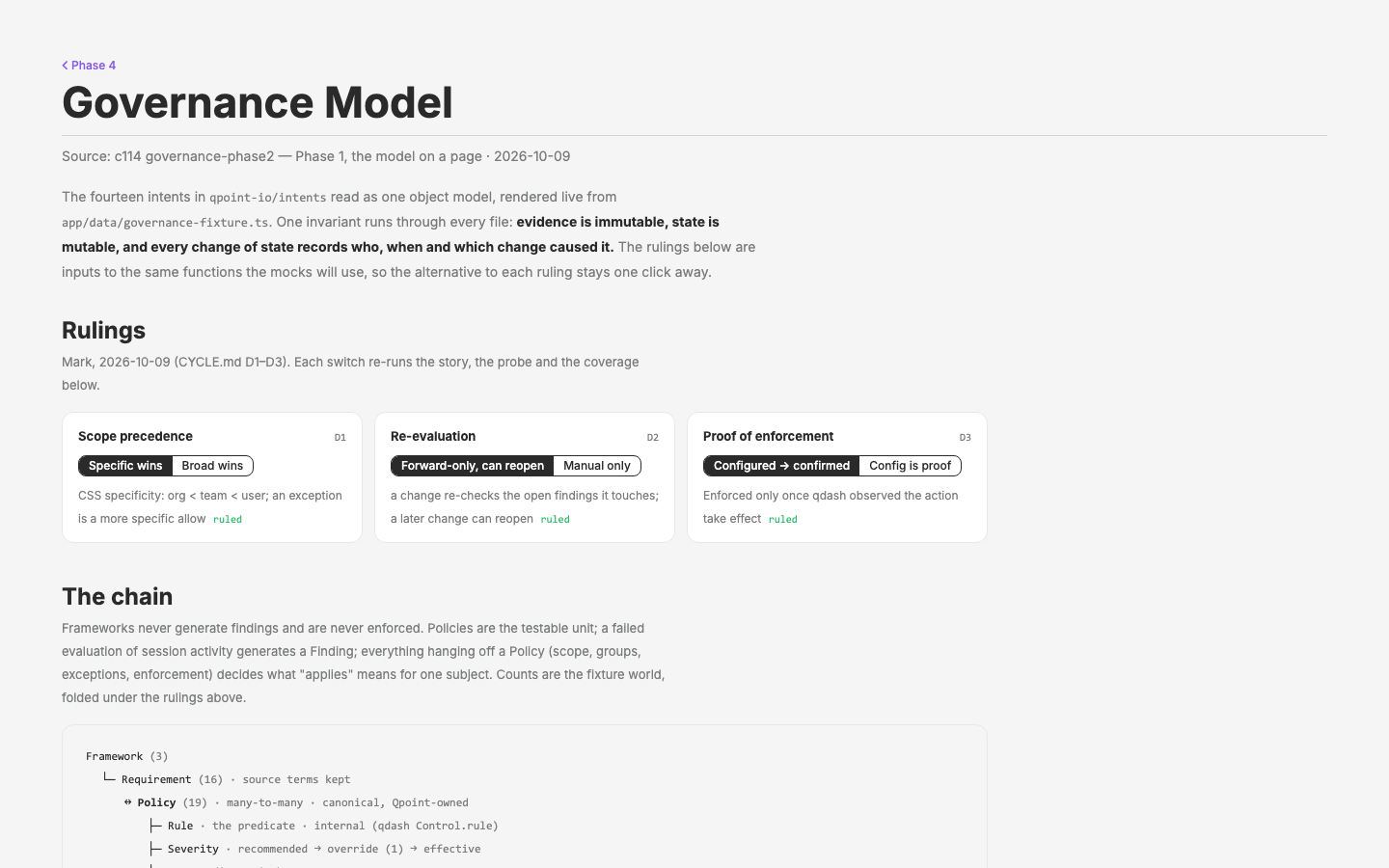
The fourteen intents as one object model on a page: the chain, object cards (stored vs derived), the Vanta story run to its end under the D1–D3 rulings with each alternative one switch away, the effective-policies probe, derived framework coverage, the lifecycle organ
Commits
52 commits across 4 repos, on each repo's checked-out branch.
Cycles
Started 4
Build the Phase II governance dashboard for qdash around the object model the ../intents repo describes, so that Findings, Policies, Scope, Groups, Exceptions, Enforcement and Frameworks appear as one coherent system rather than fourteen features
Serve the qdash demo as pre-computed worlds (sizes, scenarios, First run stages) from files, switchable instantly, baked daily, with no containers at serve time
A public qdash demo on Cloudflare Containers whose synthetic world rolls forward every 2 minutes, in four sizes, with a violation mix and triggerable scenarios set from a gated control panel
A weekly view of the cycle atlas (started · still open · closed per week) beside the existing numerical view, plus a week details page designed as a _meta mock
Still open 20
Execute Mark's 2026-10-01 product-review notes for /activity through /todos
Promote the Fable app to qcontrol/crates/qdash/ui/ (the path the binary embeds), land it on feat/new-pages / PR #713, archive the old ui and the Opus app as reachable tags, and tell the story of why
Re-evaluate the qdash /cost page against what the backend now serves, and re-draw it on the Organization / Inventory listing pattern
Fold qmap into DataSurfaceSection. Draw a thing's Surface (what it reaches) as a scene of pixel pawns, as a second view beside the lists (Map ⇄ List). This starts with a design brief to a designer.
Design the three qdash "Design in progress" landings: Home /, /inventory and /team. Each is a 30 ft (300 ft for Home) view of its domain, made more of images than of text.
Audit every qdash page's data provenance, write the front-end data-interface bible (page → context component → library component; composables modelled on app.qpoint.io's), then plan and execute the conversion of the qdash UI's vibe-coded data layer onto it
Refine the qdash /teams design — composition from c61 concepts, mapping workspace as the pre-SCIM write path, slim spend overview, credentials relocated
Seat c93's UxColumnPicker on the right edge of c92's FilterTriggerBar as a default-but-optional add-on — one strip above every qdash listing table instead of two controls competing for the same edge
Turn the c92 todos workflow (Mark's per-page meeting notes → one plan per page → parallel narrow-context executors → record) into a repeatable process: a /todos skill that reads the notes straight from Logseq, a sheet grammar, a page registry, and the templates the c92 run used by hand
A checkbox popover that shows/hides a table's columns — UxColumnPicker on a new UxPopover primitive — prototyped on the design site, then extracted to q-nuxt-layer and wired into a qdash listing
Reshape market-analyst into a design tool first — the source of truth for Qpoint's problem space — by adding a micro-problem layer (use case → micro problem → observations) on top of the existing market lens, with a curated registry, extraction-proposed candidates, computed standing, product surfaces, document intake, and briefs/stories that cite problems.
Stand up the c90 qcontrol-preview pages in the real qcontrol app (qdash UI) — phase 1 the combined Teams, Users & Devices listing, alongside a qdash global filter that replicates app.qpoint.io's behaviour, then the remaining detail/listing pages
Assemble seven page mocks (Teams & Users, User Details, Team Details, Sessions, Session Details, Devices, Device Details) behind shared app chrome that mimics the real qcontrol shell, ahead of integration with the real app
Explore and integrate Avoma notes data into extraction pipeline and dashboard visualizations.
Refine how extracted data is displayed in the dashboard and improve extraction quality where gaps exist.
Add Google OAuth to restrict dashboard access to @qpoint.io team members.
Methods & tooling retro — evaluate how we work against the design methodology, restore order, modernize the skill/agent tooling, and make the philosophy load-bearing
Build-partner portal — research, ideation, and a plan for a page that makes partners insiders
Align the qcontrol agent-monitoring dashboard to specific personas and find market alignment — hypothesis-first, validated against calls later.
Closed 1
A public qdash demo on Cloudflare Containers whose synthetic world rolls forward every 2 minutes, in four sizes, with a violation mix and triggerable scenarios set from a gated control panel
Pages & components
What this week's captures picture — 9 pages · 7 first captured this week. Each links to its evolution: every moment it was shot, across cycles.
Pages 9
Log
Key Changes entries dated inside the week, from each cycle's record — newest first within a cycle.
c114 Governance Phase II
kick-off (2026-10-09): the playbook thread became this cycle (initial-prompt.md). Read all fourteen intents plus README; grounded against qdash's current contract types (Finding, FindingWorkflow, Control), its four governance pages and seven API routes, the design site's c64/c65/c79 mocks, the layer's security/compliance/data parts, and seven matching problems in the registry. Plan written with six phases (plan.md).
rulings (2026-10-09): D1–D6 ruled in conversation (CSS specificity, forward-only re-evaluation that can reopen, two enforcement states, the intents' words, all eight mocks, design leads).
Phase 0 (2026-10-09): object-model.md written: the invariant, the chain, eleven objects with stored/derived split, relationship table, five lifecycles, what each ruling does to the model, the fixture world (three stories from the intents' own examples), the crosswalk (intents ↔ qdash contract ↔ design-site mocks ↔ layer), seven gaps for the intents repo, and the Source note mapping intents to seven registry problems. Awaiting Mark's read and Mark Peterson's "that is what I meant."
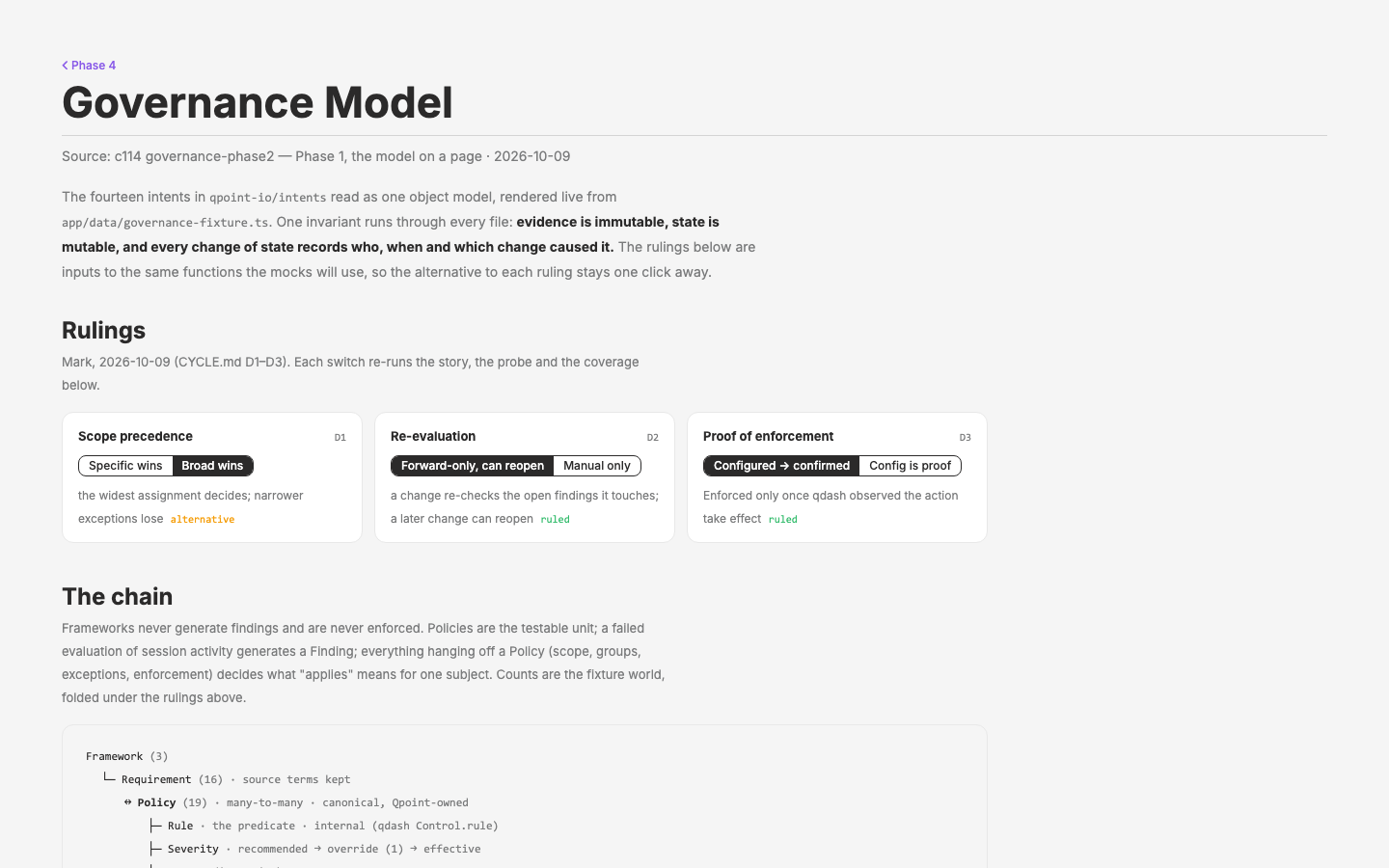
Phase 1 (2026-10-09): the model on a page. app/data/governance-fixture.ts (the three stories as one world; pure functions applicability() for D1, foldFinding() over append-only FindingEvents, applyChange() + re-evaluation for D2/D3, coverage() for frameworks; rulings are inputs, RULED the defaults) and /pages/phase4/governance-model (rulings as switches, the chain with live counts, ten object cards stored-vs-derived, the Vanta story run to its end in seven frames, the lifecycle organ, the effective-policies probe, derived coverage). Verified in the browser: the story reaches its end under every ruling and the alternatives differ where the intents say they should (broad wins: the Team A exception loses and A is only resolved by enforcement; manual only: A waits for a person; config is proof: B resolves on publish). Three captures via scripts/shot-programs/c114-governance-model.json (ruled, d1=broad-wins, d3=config-is-proof), subject page/governance-model. Registered in page-registry.ts under collapse c114-governance; moved from _meta to the new Phase 4 the same afternoon (D7) with a Phase 4 index and a card on /pages, and recaptured at the new route. Committed as d84d131ac.
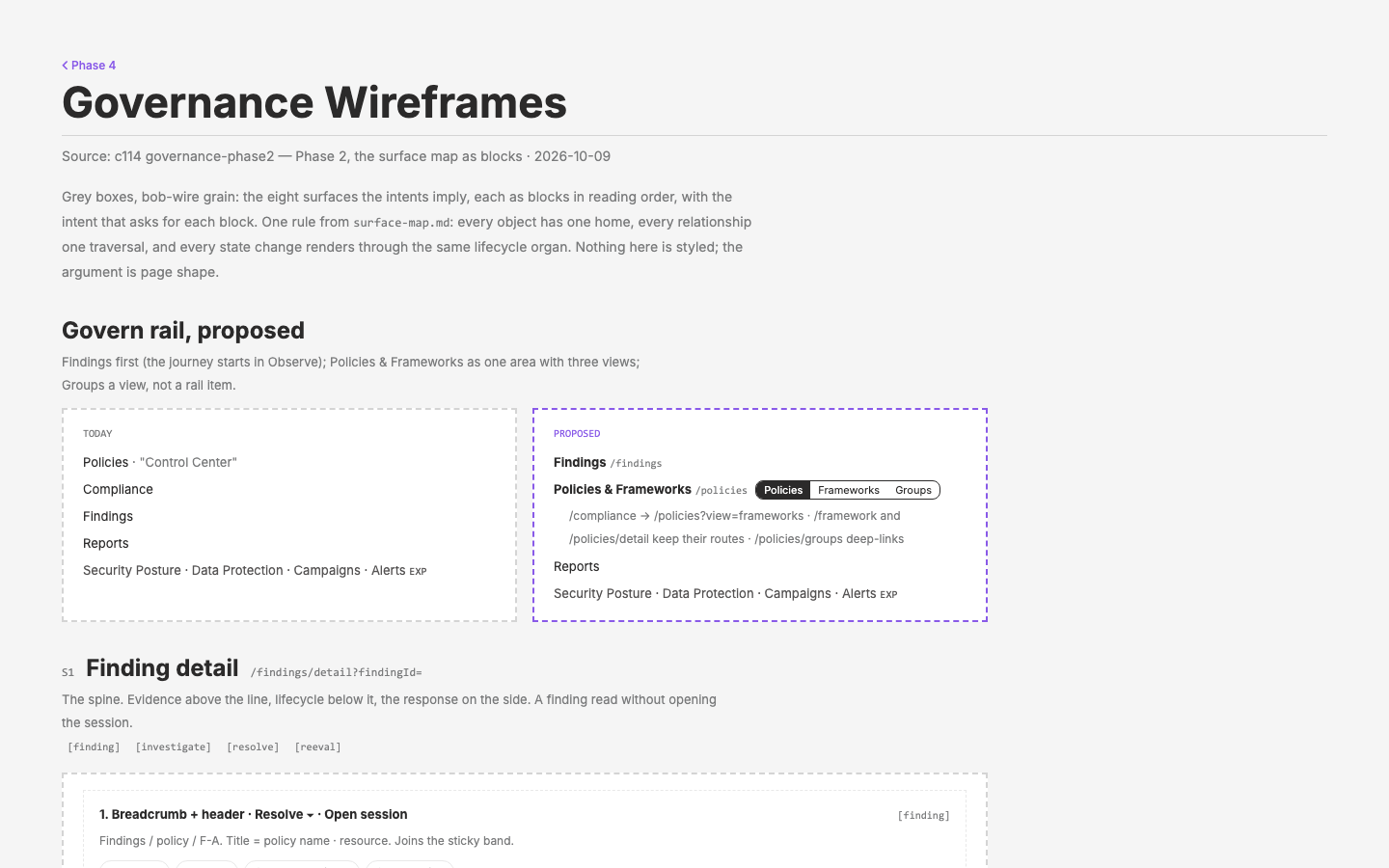
Phase 2 (2026-10-09): the surface map. surface-map.md: homes (one per object; Scope, Enforcement, Exceptions and Change deliberately not pages), traversals (one per relationship), the intents × surfaces matrix (every intent has one primary surface; re-evaluation shows as organ rows and preview counts), the Govern rail proposal (Findings · Policies & Frameworks with Policies / Frameworks / Groups views; /compliance redirects), the eight surfaces as blocks with what carries over, what is new and the four states each mock renders, the organ's placement, the five-question check per surface, and the open questions the mocks will settle. Rendered as grey boxes at /pages/phase4/governance-wireframes (registry governance-wireframes, captured as c114-governance-wireframes). Committed as 2465c12c8.
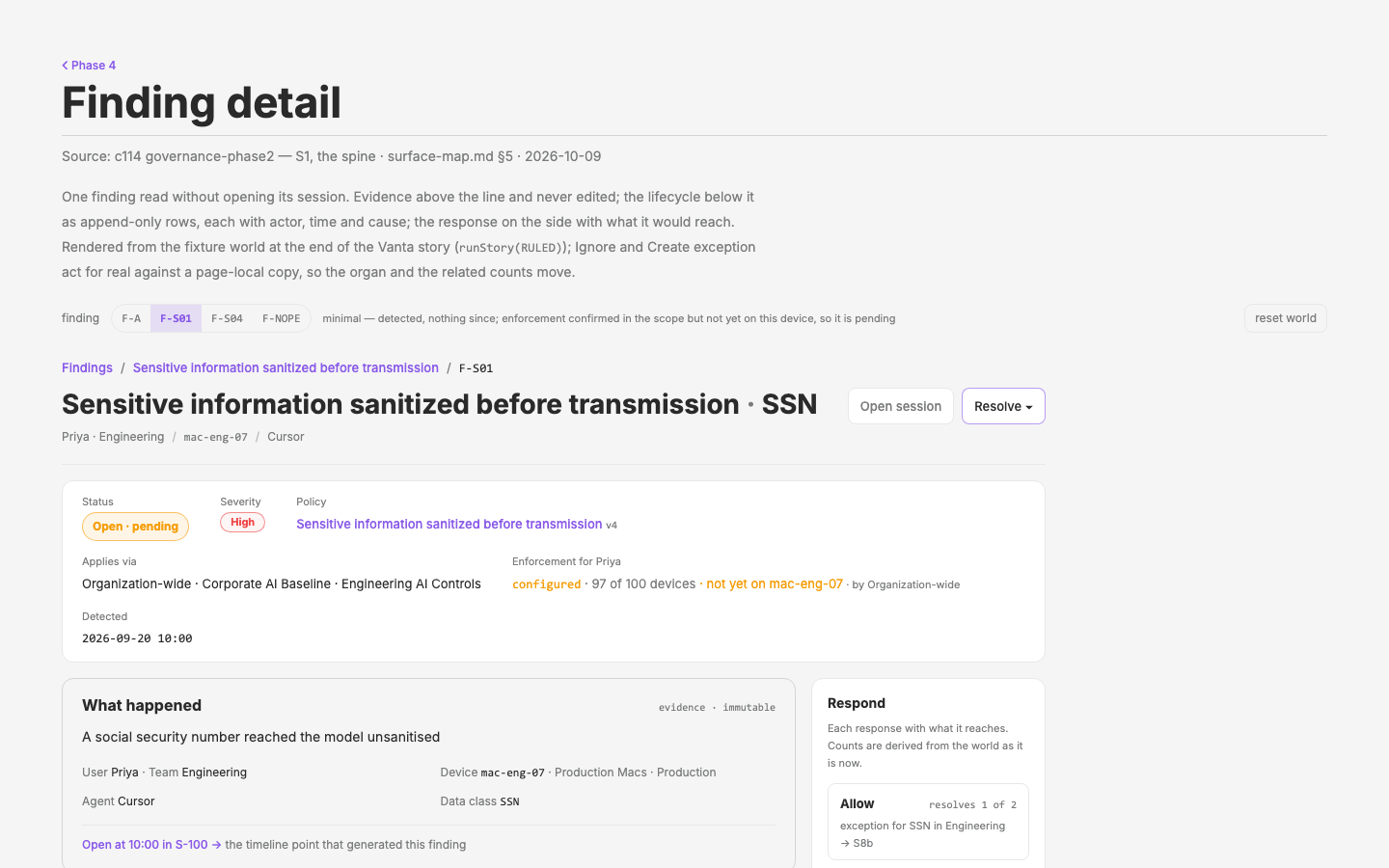
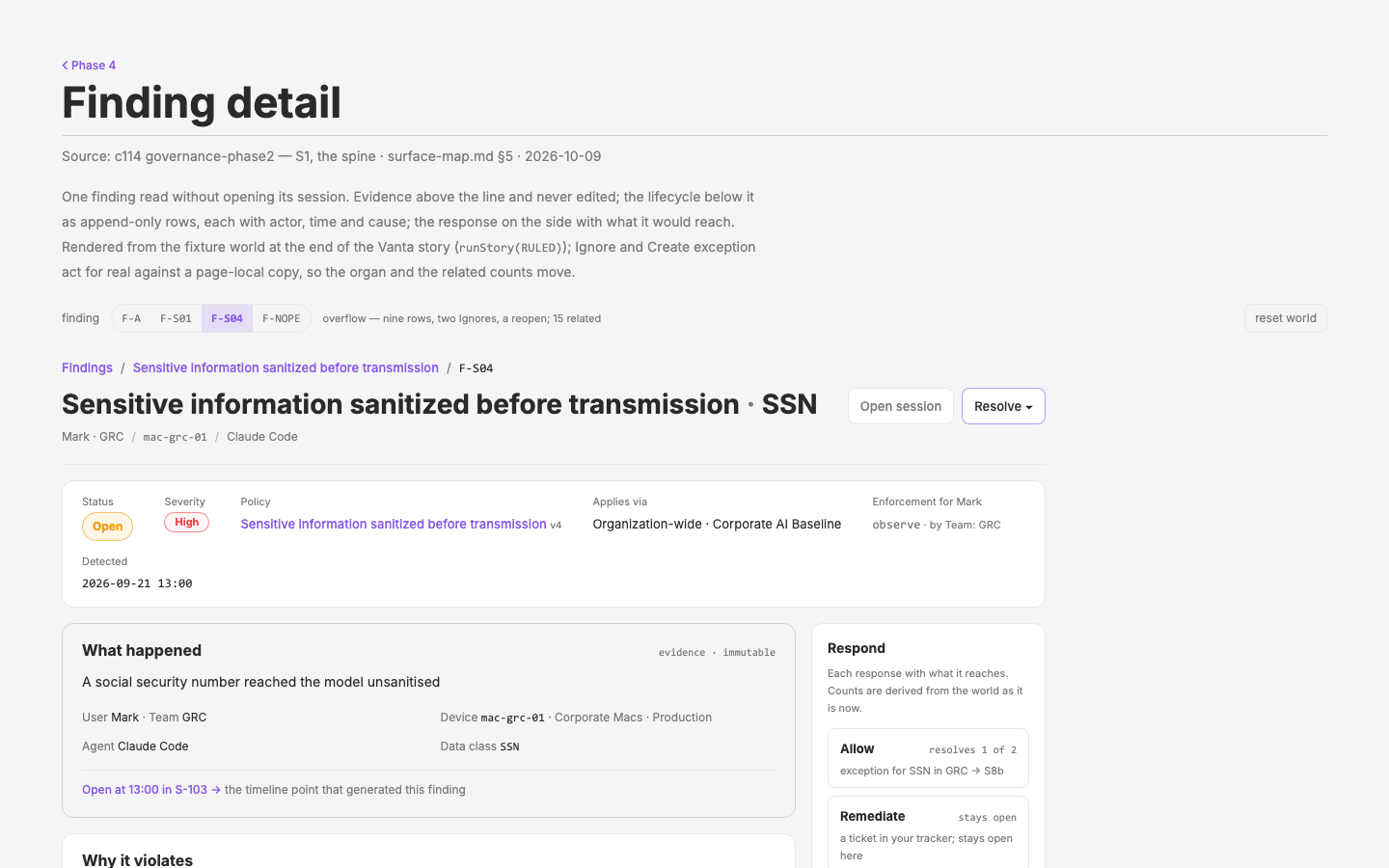
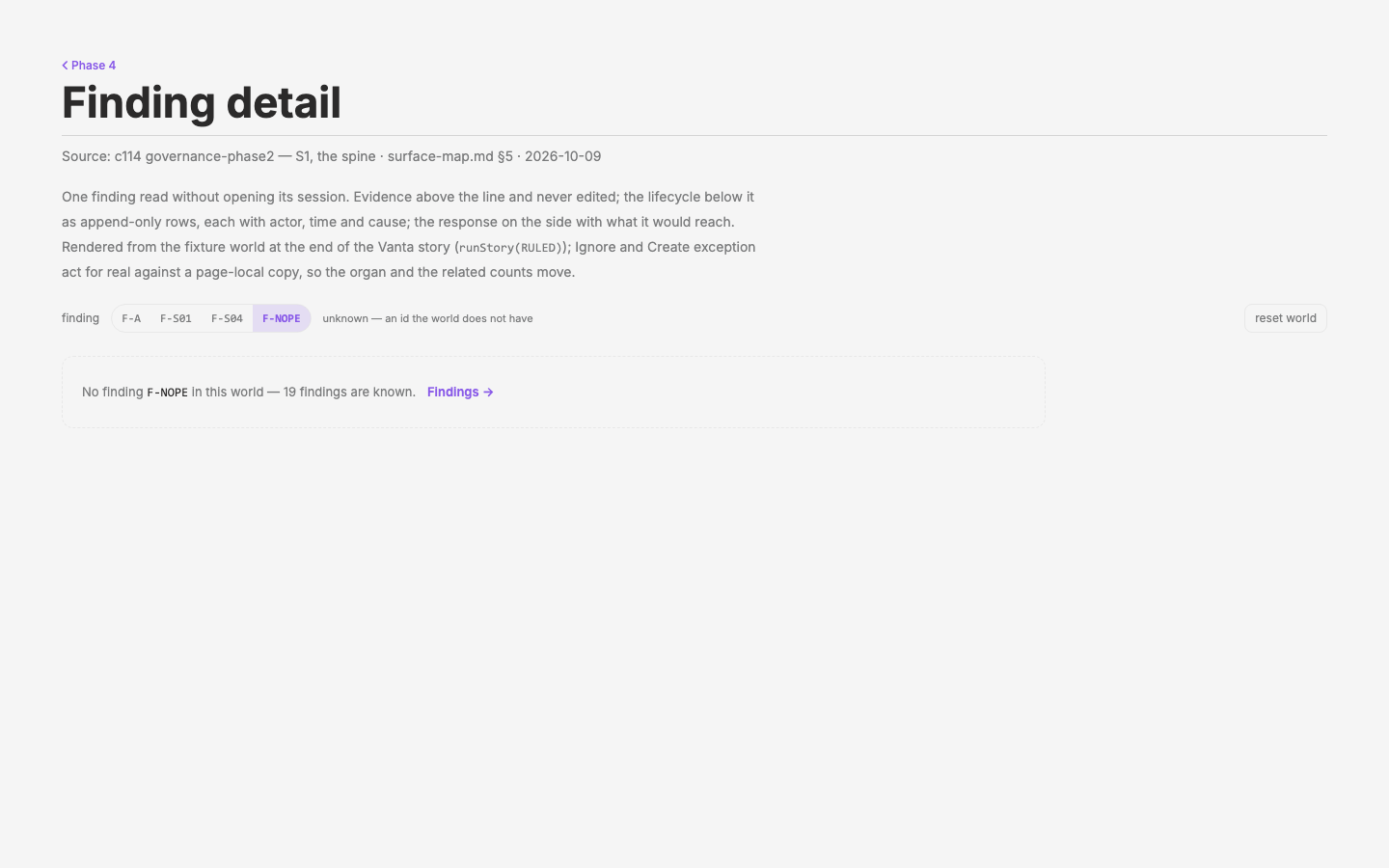
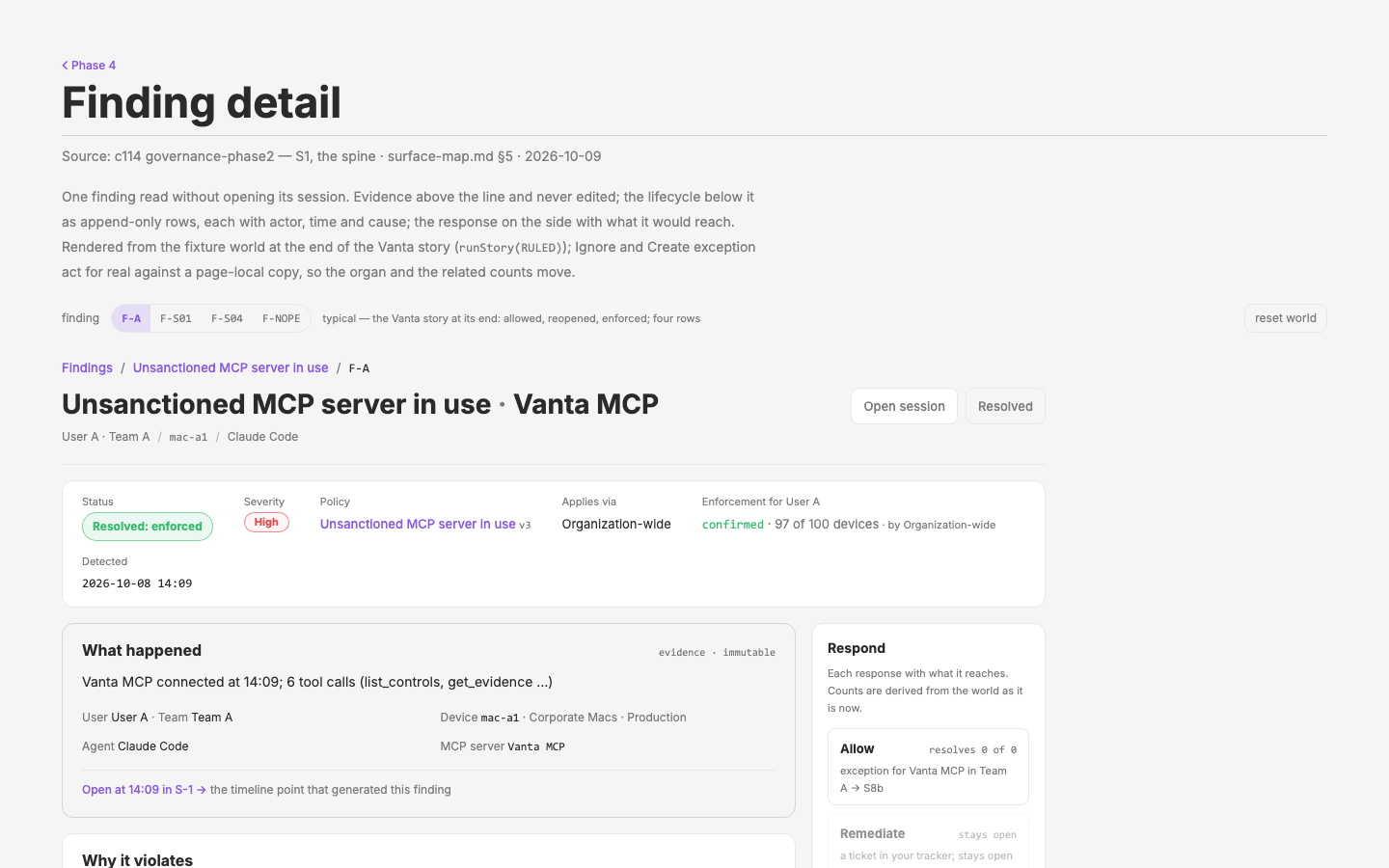
Phase 3 · S1 Finding detail (2026-10-09): /pages/phase4/finding-detail on the fixture world at the story's end, four states by ?findingId= (F-A typical · F-S01 minimal · F-S04 overflow · F-NOPE unknown). Blocks per surface-map.md: crumb + header with Resolve ▾, the band, What happened (sunken, immutable), Why it violates (computed: paths, exceptions considered, still a violation now), the lifecycle organ, related findings, the Respond aside with derived reach. Ignore (required duration, the blank-reason warning with Confirm / Cancel / Don't ask again, then Done / Create an exception) and Create exception (scope picker with specificity, derived preview, re-evaluation) act for real against a page-local world; verified in the browser on F-S04: the organ gained its rows, the finding went Resolved: ignore, then the exception made it Allowed and "still a violation" turned no. Fixture gained the overflow history (F-S04: two Ignores, expiry, revoke, Enforced, reopen on CH-G1, a third Ignore revoked) and a Team GRC observe entry. Four captures. S1 reuse inventory in surface-map.md §5. Lesson: the design dev server served a stale transform of the new page (no edit after creation reached it; an unchanged touch nuxt.config.ts did nothing; a real one-line config change restarted it in place and fixed it, reverted after). Committed as b9b7e3f14.
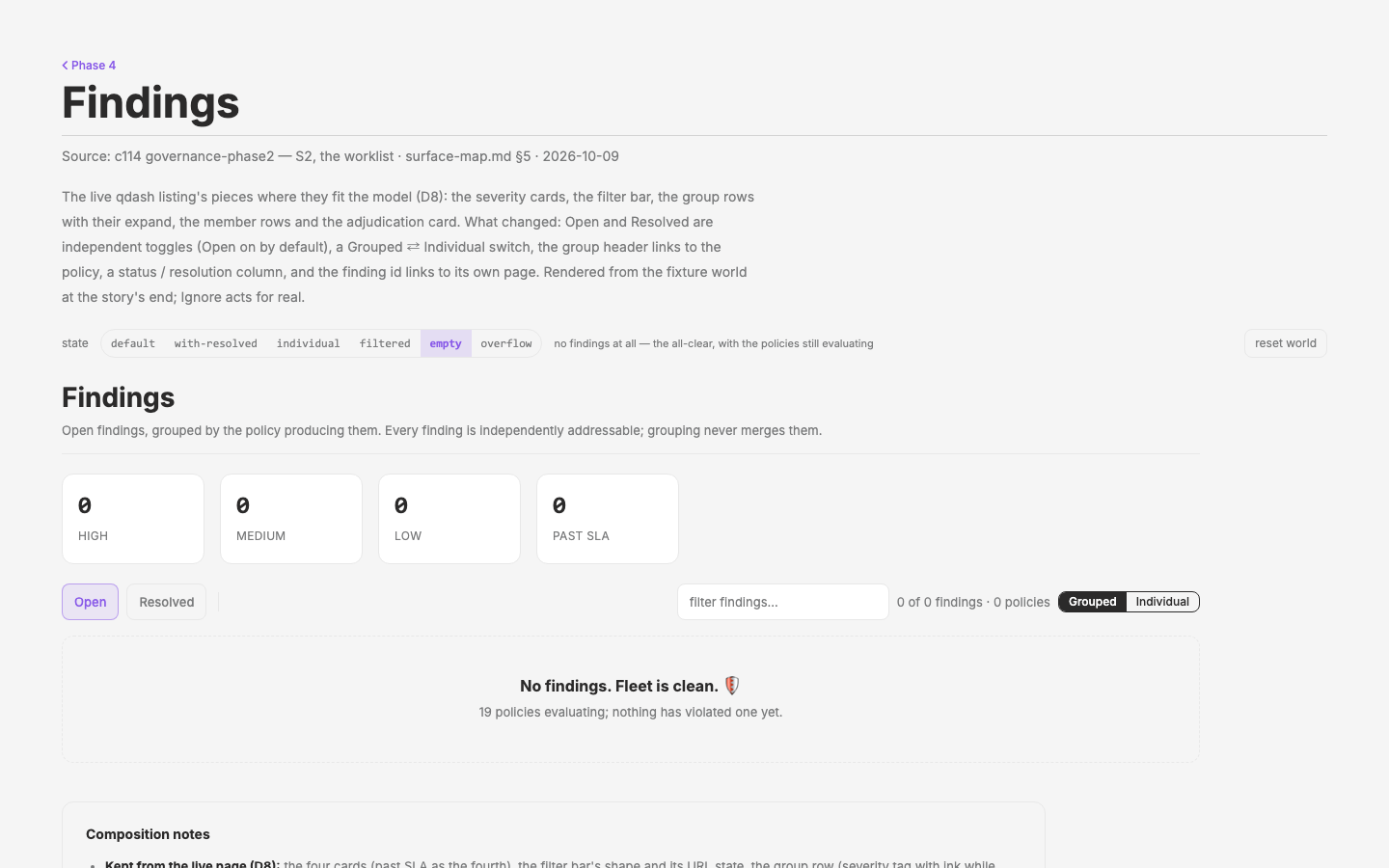
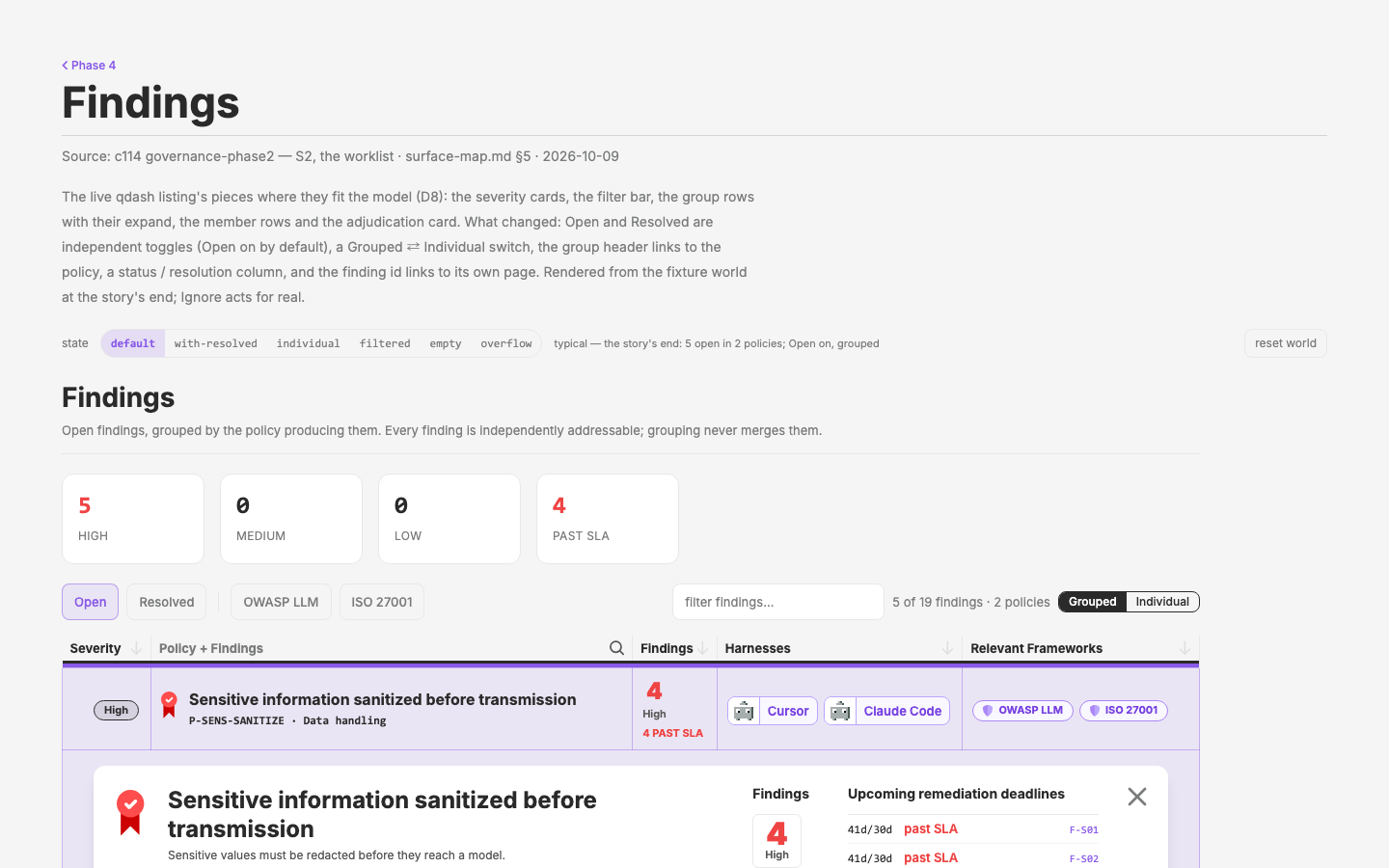
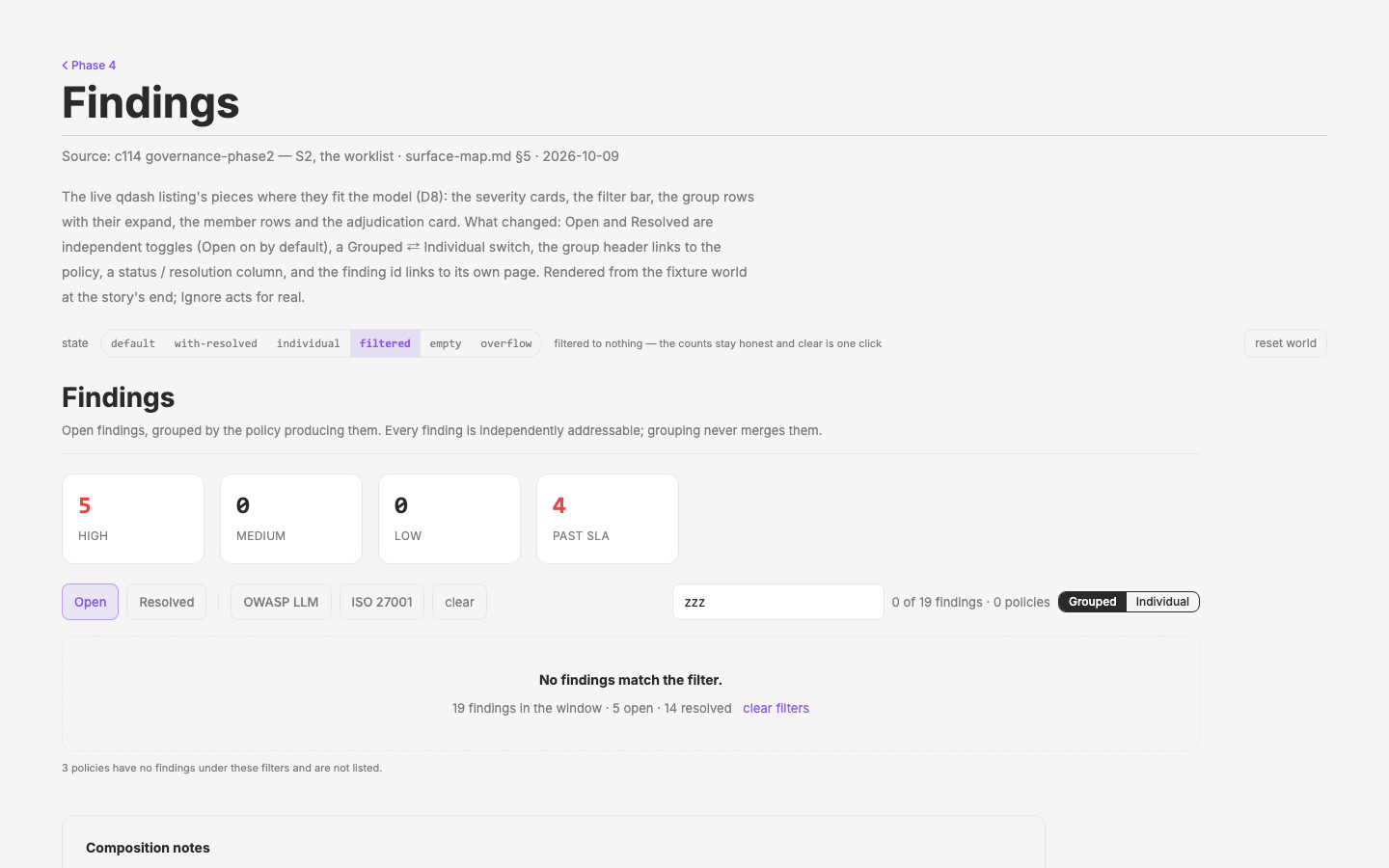
Phase 3 · S2 Findings (2026-10-09): /pages/phase4/findings from the live listing's pieces per the D8 inventory: the four severity cards (past SLA fourth), the filter bar on URL state (?status=&sev=&fw=&policy=&team=&q=&view=), group rows per policy (severity tag with ink while open, ribbon, severity cells, harness pills, framework tags, sorters) with the policy section and the member rows on expand, and the adjudication card (subject · applies via · clock with Ignore / Create exception / Block, evidence beside the lifecycle) with Ignore live. Changed: Open and Resolved as independent toggles (Open default), Grouped ⇄ Individual on the ink switch, the group header linking to the policy, a status / resolution column and a last-event cell, the finding id linking to S1; the handling select retired; groups with nothing under the filters disappear and the page says how many. Fixture gained frameworksFor, the c79 SLA clock (slaClock, SLA_RUBRIC) and withOverflow (400 deterministic findings). Seven captures: default, with-resolved, individual, filtered, empty, overflow, expanded (group open, first member's card). Verified in the browser: expand, the card, the Ignore warning and Confirm (the row leaves the Open view and returns under Resolved). Committed as 5429239a2; deployed the same afternoon.
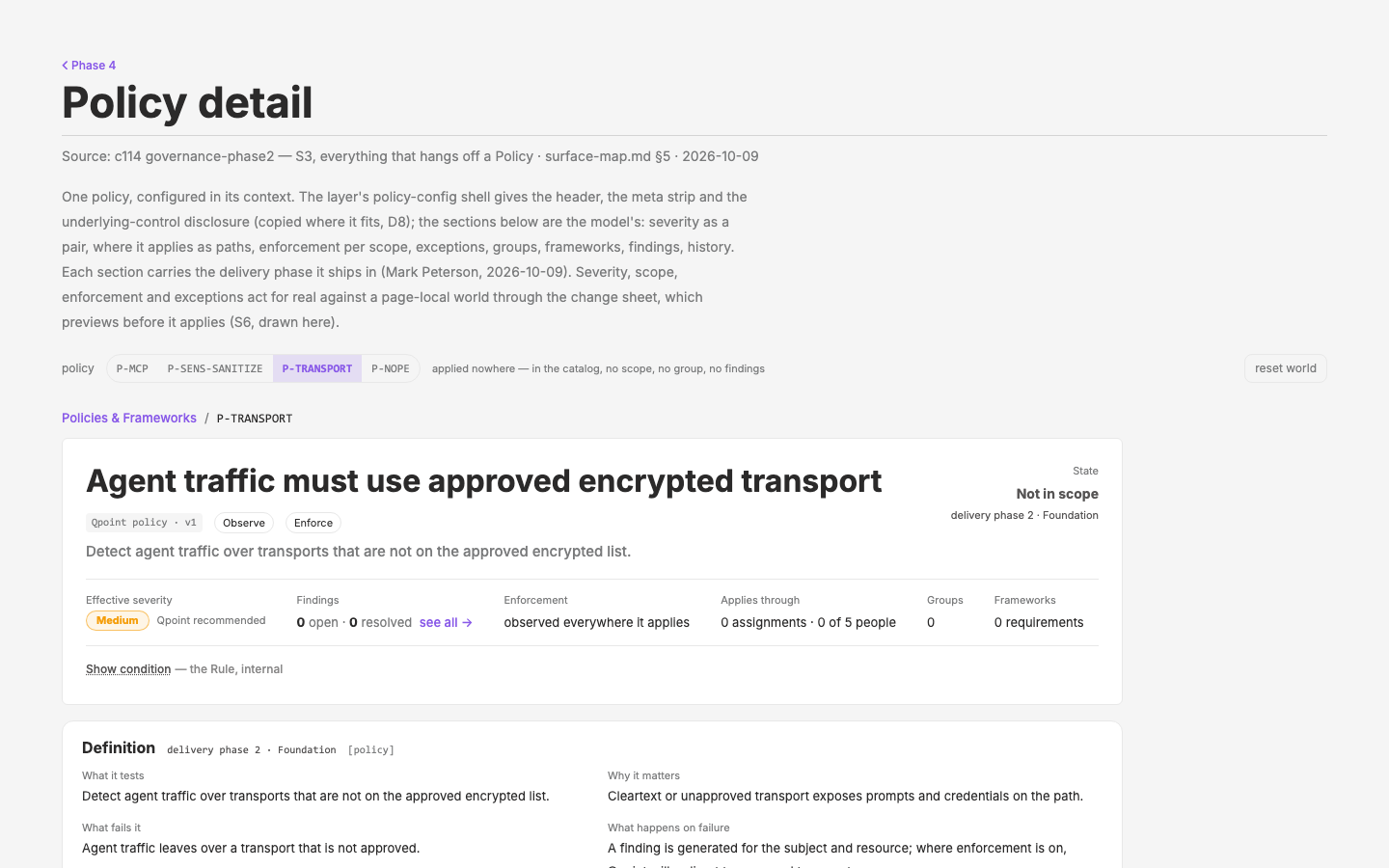
Phase 3 · S3 Policy detail (2026-10-09): /pages/phase4/policy-detail, four states by ?policyId= (P-MCP typical · P-SENS-SANITIZE rich · P-TRANSPORT applied nowhere · P-NOPE unknown). The layer shell's header, meta strip and condition disclosure copied where they fit (its Exceptions block is not seated: old scope words, no resource; a slot is the layer follow-up); beneath: Definition, Severity as the recommended / configured pair with Set and Reset (live), Where it applies as scope paths with specificity, enforcement at each scope, population, overlap and conflict callouts and the effective-for-a-person probe, Enforcement per scope with reach and observe-first guidance, Exceptions (resource · scope · reason · until · by · revoke), Groups, Frameworks as mapped requirements, Findings, History as the organ. Every section tagged with its delivery phase (Mark Peterson's 2 Foundation / 3 Organization / 4 Applicability). The change sheet is S6 and S8b drawn in place: add / remove scope, enforce / observe per scope, add / revoke exception; previewChange() dry-runs the change on a clone and reports population, reach (broadens / narrows), duplicate paths, equal-specificity conflicts (apply blocked until resolved), findings that resolve / reopen / resolve as Enforced, and the observe-first counts; the audit line shows the History row it adds. Fixture: why · fails · rule on every policy, P-TRANSPORT (no scope), scope-add / scope-remove changes, scopeRows, overlaps, policyHistory, previewChange, scopeValues. Five captures including the sheet open. Verified in the browser: the sheet's preview and apply (Team: Legal added, History row), severity Reset, the Enforce and Create exception previews. Committed as 5a797bbb8.
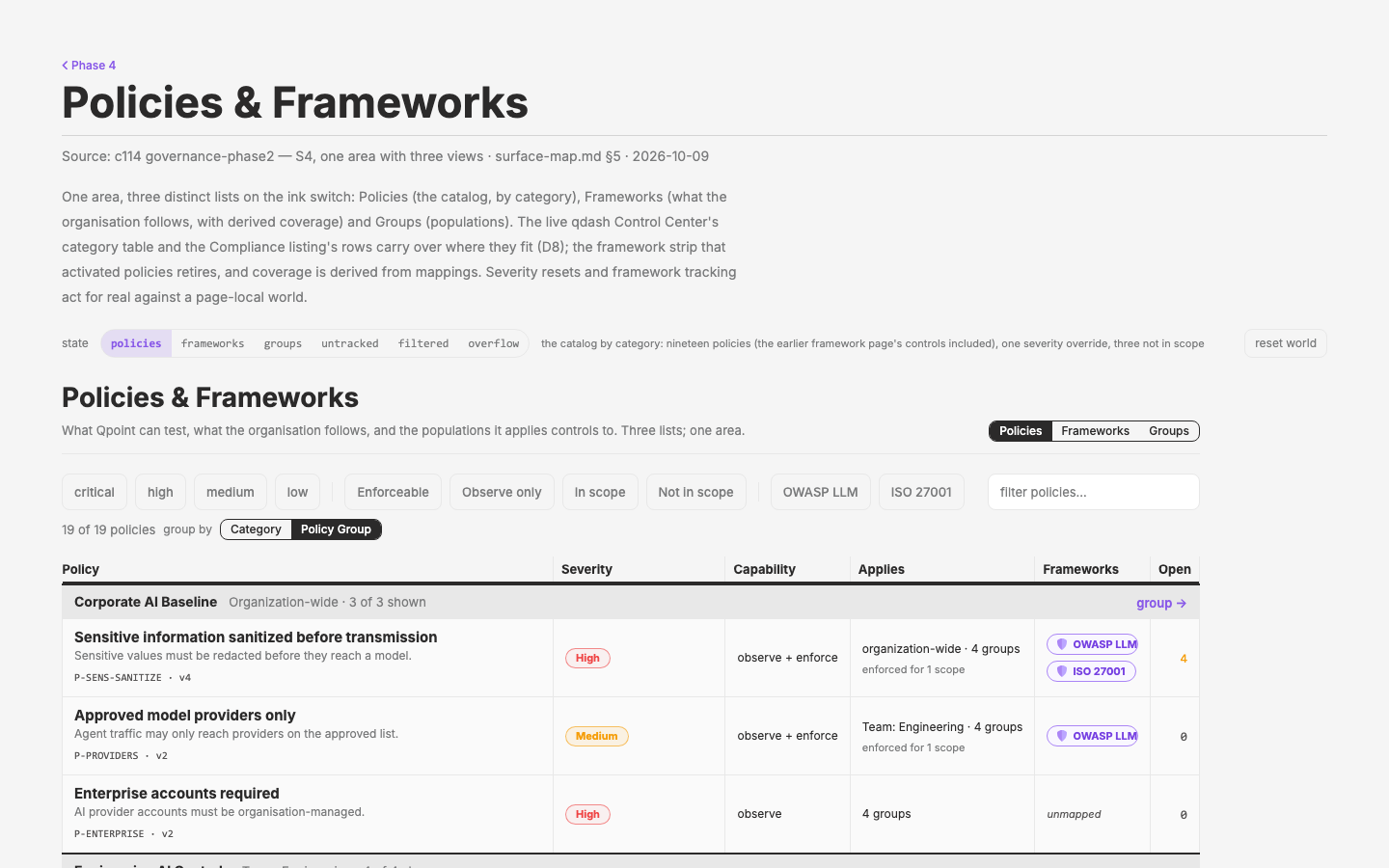
Phase 3 · S4 Policies & Frameworks (2026-10-09): /pages/phase4/policies, one area with three views on the ink switch (?view=policies|frameworks|groups). Policies: the Control Center's category sections and rows kept (D8); severity as effective with the recommended value and an inline Reset (live); the activation toggle replaced by an Applies column (organization-wide · N groups · Not in scope) with the enforcement summary; framework tags; open findings → S2; group by Category ⇄ Policy Group (then "Not in any group"); chips for severity, capability, in scope, framework; search. Frameworks: the Compliance listing's row kept; one list with Tracked (live, changes no policy); derived coverage counts per framework; open findings through mapped policies. Groups: S7's list (policies · scope with population · state · enforcement summary · open; New group, Duplicate as seams). Fixture: tracked on Framework, framework-track change, applicabilitySummary, withManyPolicies (the 69-policy overflow). Seven captures. Verified in the browser: Reset clears the override, group-by shows the four groups then the ungrouped, Track flips ISO to Tracked. Committed as 81a127765.
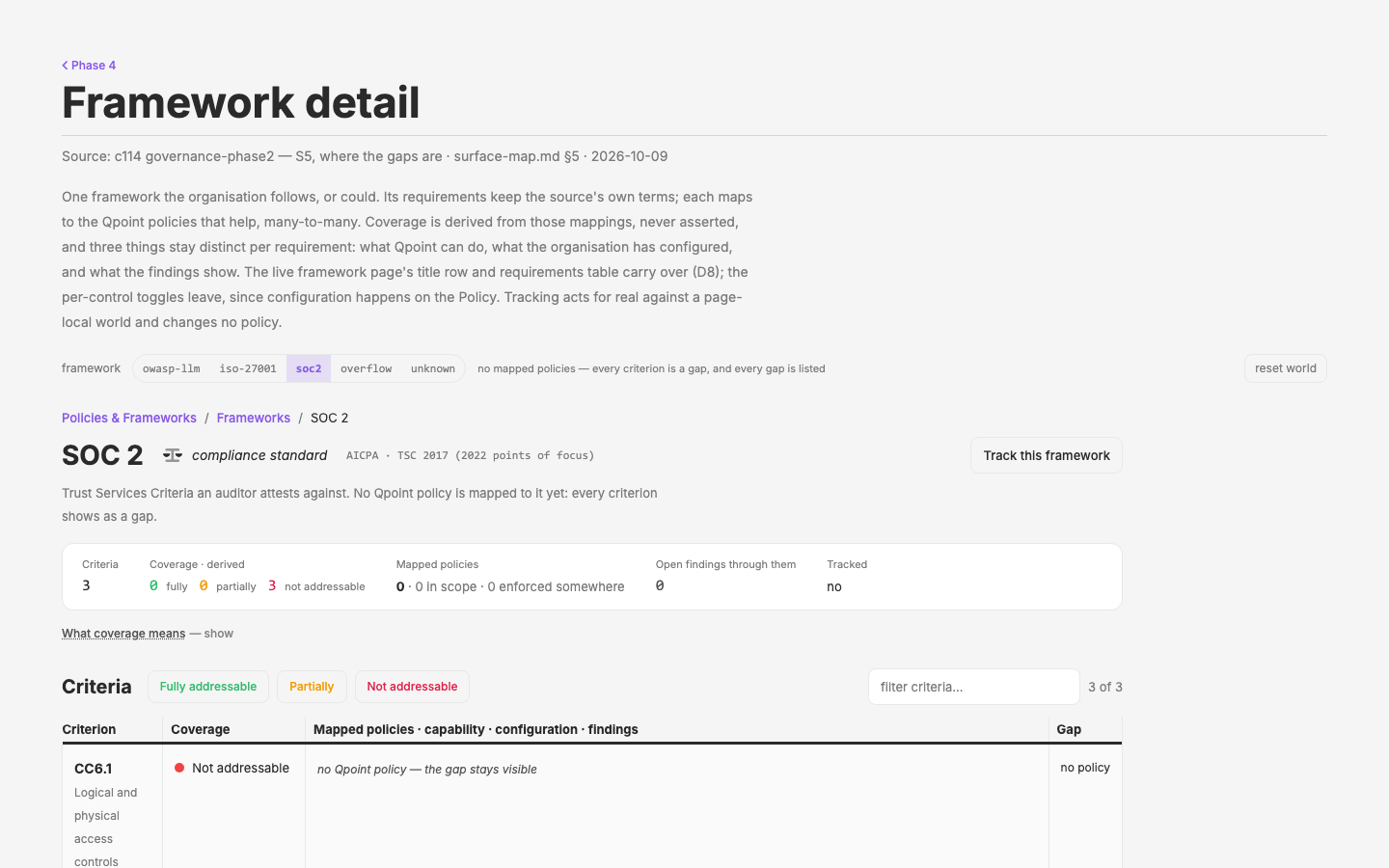
Phase 3 · S5 Framework detail (2026-10-09): /pages/phase4/framework-detail, five states (?frameworkId=owasp-llm typical · iso-27001 untracked · soc2 no mapped policies · iso-27001&state=overflow 93 controls · NOPE). Mark's steer: the earlier framework page (qdash /framework, c56 mock) is the starting point, the new phase takes precedence. Kept from it: the title row, the table shape, all ten OWASP risks with their fit notes (Requirement.note, shown beneath the state), and its satisfying controls, which the catalog now carries as ten policies (nineteen total; P-PROVENANCE and P-SPEND left unassigned, so three policies read Not in scope). Changed: Activate → Track (changes no policy, live); the hand-set addressability dot → the derived coverage state; one controls cell → capability · configuration · findings as three cells; added the gap-reason column, the summary band, the Gaps list never hidden, coverage filter chips, the "What coverage means" disclosure and the risk-taxonomy caveat; retired the per-control toggles, Activate all, the progress bar. Fixture: sourceTerm and description on Framework, SOC 2 (no mappings), gapReasons, withManyRequirements. Five captures; S4 captions and copy updated for the larger catalog. Lesson: the two-day-old dev server was serving stale transforms and the machine was at load 10 from Spotlight and fseventsd; Mark restarted the server (fresh process picks up new pages without a nudge). Committed as 1fbc18f78.
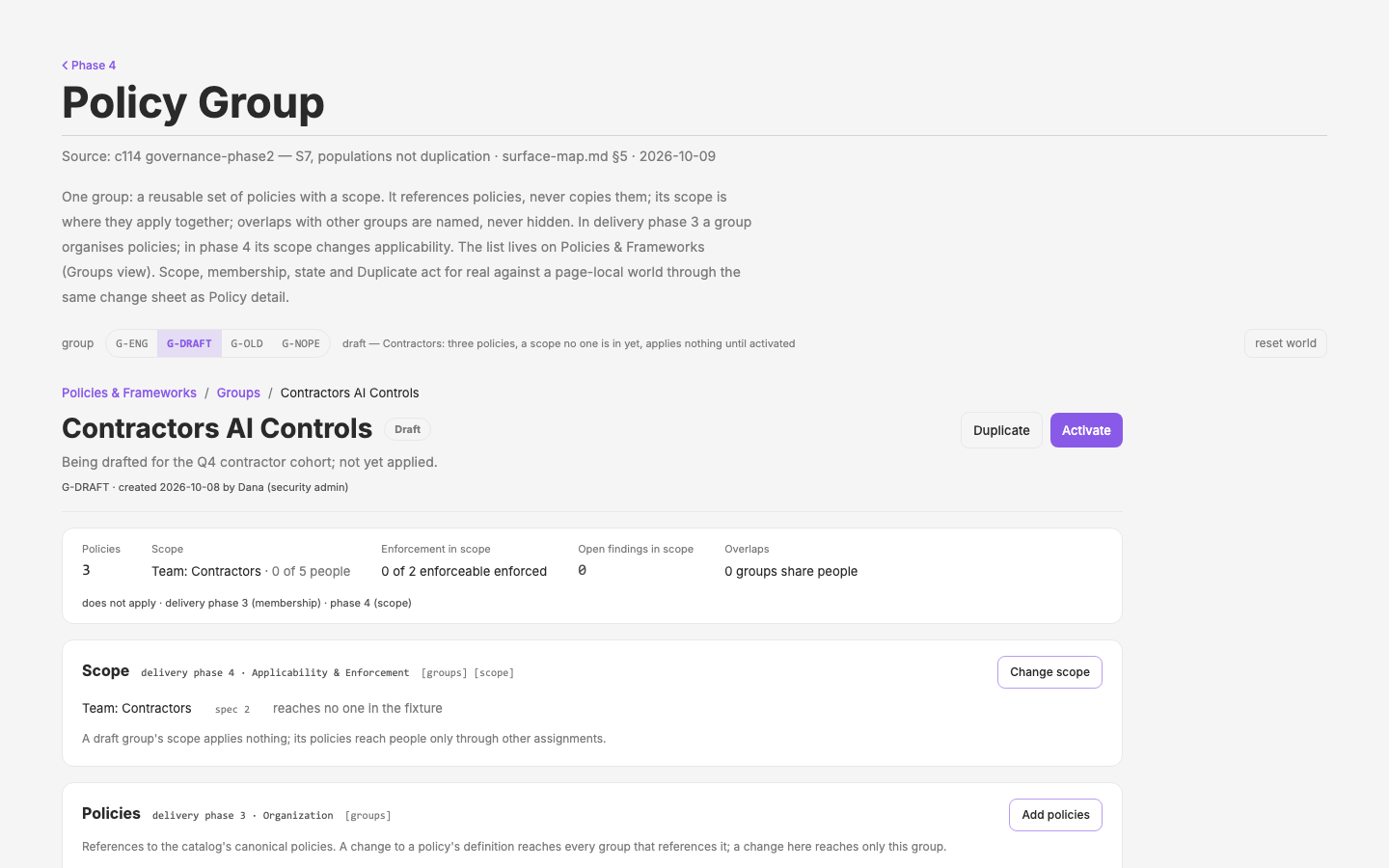
Phase 3 · S7 Policy Group (2026-10-09): /pages/phase4/policy-groups, four states (?groupId=G-ENG typical · G-DRAFT draft · G-OLD retired · G-NOPE). Header with the state pill and Duplicate · Activate / Retire / Re-enable; the band; Scope with the change sheet (S6 reused); Policies as references with severity, capability, enforcement in this scope, open in scope and "also in", Add from the catalog and remove per row; Overlaps naming every other active group that shares people, the shared policies and any equal-specificity enforcement conflict, plus the effective-policies probe with this group's policies in bold; History as the organ. The sheet previews population, re-evaluation and conflicts for scope, membership, state and duplicate; Duplicate creates a draft referencing the same policies and opens it. Fixture: draft state, createdAt / createdBy, G-DRAFT and G-OLD, the group-change record (create · scope · policyIds · state) in applyChange, four group history rows. Five captures. Verified in the browser: the scope preview, adding Restricted file access (policies 4 → 5, History row), Duplicate opening the new draft, Activate flipping it active. Committed as 04ddb4cab; deployed (live record 2026-10-09T21:33Z, all eight Phase 4 pages).
fixture · reach per device (2026-10-09): the S7 sheet surfaced that the four open sanitization findings sat under organisation-wide enforcement already confirmed on every device, so any change touching the policy previewed them resolving as Enforced. D3 is now per device: EnforcementState.reach.pending names the devices enforcement has not reached, and applicability() returns configured (with pendingDevice) for a subject on one of them. The sanitization enforcement is confirmed on 97 of 100 with the three devices behind F-S01..F-S03 pending; those findings read Open · pending, S1 says "not yet on mac-eng-07", S3's Findings block counts 3 pending, and the group sheet previews no Enforced resolutions. Captions updated; every shot recaptured. Committed as 0f5cbcb66.
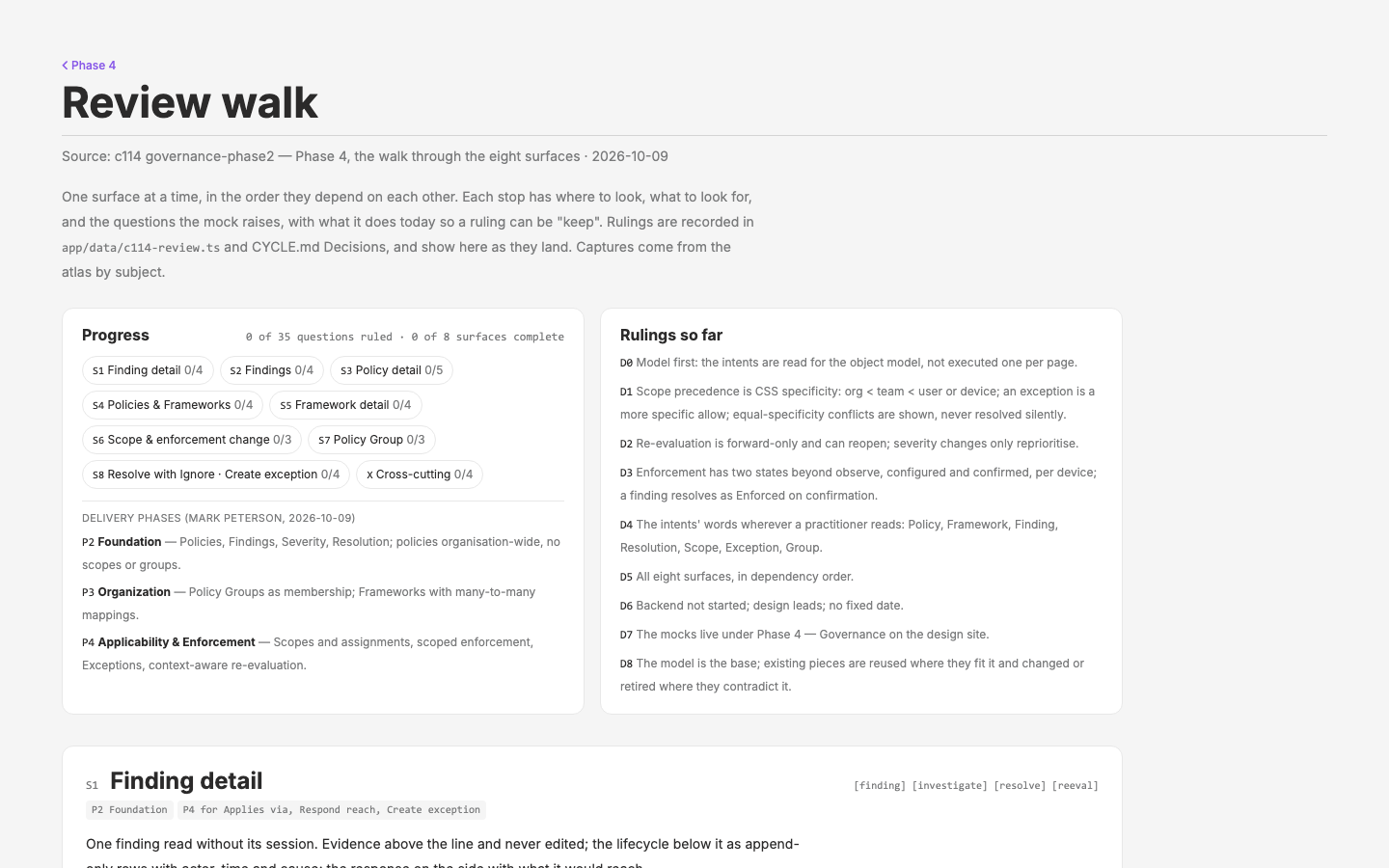
Phase 4 · the review walk (2026-10-09): /pages/phase4/review-walk reads app/data/c114-review.ts (eight stops in dependency order: where to look with every state linked, what to look for, the captures by subject from the atlas manifest, and the questions each mock raises with what it does today; cross-cutting questions on the delivery phasing and the model; the rulings so far and Mark Peterson's delivery phases up top; progress counted from rulings). Rulings are recorded in the data file and in Decisions here as they land, so the page is the living review record. Thirty-five questions open at the start. Committed as eac972b12; deployed (live record 2026-10-09T21:58Z).
parked for the weekend (2026-10-09): PICKUP.md written; the walk resumes Monday 2026-10-12 with a fresh agent. Ten c114 commits today, all deployed; nothing of the cycle's uncommitted.
c113 qdash Baked Demo
Phase 3 done; full bake; cutover (2026-10-07): bake.sh and check.py --baked (phase3-upload.md); re-verified 6/6 including the real-bakes test. The full bake of eleven worlds at one anchor (2026-10-06 19:24 UTC) took 3.5 h on the laptop with 0 errors: Small 17 s, Mid-sized 29 min (141k answers, 191 MB), Enterprise 62 min (201k, 261 MB), each Mid scenario world ~29 min, First run stages 1 s to 78 s; 1.2 GB in all. Cutover on Mark's go: bucket qdash-demo-worlds created on the Qpoint account, the worlds uploaded through wrangler (--remote; note wrangler's r2 object get reads local state unless told --remote), catalog last, then wrangler deploy --config wrangler.baked.jsonc over the same Worker name. The first deploy was refused (error 10064: the version stopped exporting the Durable Object classes the live containers depend on), so the baked entry now exports the four classes as inert stubs; a deleted_classes migration removes them once the containers are gone. Version f7155e3a serves demo.qpoint.io as of 18:26 UTC. check.py --baked against the hostname: E1 2,069 API reads over all eleven worlds, 0 misses; E2 every page cold in 400–800 ms (Teams was 3–8 s and timing out before); E3, E5 pass; E4 passes after a check fix (shadow-AI findings carry their time in first_seen). Single calls on the hostname: /api/stats 0.10 s, /api/skills 0.43 s. Held for Mark's review: deleting the four container applications (step 5), which ends the running demo and its spend. Product finding on the way: at Mid every install reads instrumented: true in /api/installations (qdash's type_seen rule marks a tool type instrumented if any instance of it was ever observed) while /api/security lists 24 shadow installs; Inventory's coverage and Findings disagree.
containers deleted, c112 closed, the baker built (2026-10-07): on Mark's "make it so": the four container applications deleted, the v2 deleted_classes migration deployed (version 59ee049e) and the stub classes removed; c112 closed with its outcome and archived. The scheduled baker (phase4-baker.md): Dockerfile.baker (qdash Linux binary, python3, curl, the generator, bake.sh) with an entrypoint that opens a log port, runs bake.sh --world … --upload and exits with its code; in the Worker a QdashBaker container class (standard-4, one instance), scheduled() mapping two crons (Mid-sized daily Mon–Sat 09:00 UTC, all eleven worlds Sunday 06:00 UTC) to world lists, POST /_admin/bake and /_admin/bake/status behind Access, and a "Bake now" section on the picker; v3 migration adds the class. Proved locally in OrbStack at 4 CPUs against a fake S3: Small end to end in 52 s (host: 16 s, so ~1.5× slower at 4 vCPU; nproc inside reports the host's cores, so --workers 8 is a var). Estimated cost: a Mid bake ≈ $0.40, the weekly full bake ≈ $2.40, ≈ $20 a month net. Re-verified: 59/59 tests, tsc clean. Waits on Mark: an R2 API token (object read & write on qdash-demo-worlds) set as two Worker secrets, then the deploy and a first by-hand bake to measure the real standard-4 time.
kick-off (2026-10-06): the thread that found the c112 overload became this cycle (initial-prompt.md). Grounding read: the UI is a static SPA with a committed dist/; 31 API routes whose server-side parameters are period plus entity selectors, with the global filter's operators applied on the client, so the crawl space is bounded; the Worker's Deps.container(size) is the seam for a baked backend. Plan written with five phases and eight checks; S5 (crawl coverage) running first because it's the one risk.
S5 passed; Phases 1 and 2 started (2026-10-06): (s5-crawl-coverage.md) the server's query grammar plus ids harvested from answers enumerated every URL a 388-visit walk of the UI made (312 normalised URLs, 0 misses after one added rule: the agent filter on six listings). Served from files, a cold Teams page reached its last answer in 247 ms against 1,263 ms live; the index page 310 ms against 2,132 ms. The cost: a complete Mid bake is ~141,000 answers, ~430 MB and ~1.5 h on the laptop, five-sixths of it that one agent-filter affordance over 4,891 agent instances. Consequences in the plan: one pack and one index per route instead of a file per answer (R2 charges per write), and tier 2 by alias (agents with no runs in a period share one answer). Gotchas for the build: APFS case-folding silently overwrote 817 answers during the spike; answers aren't byte-stable (float sums, request-time windows), so equality tests compare parsed JSON. Phase 1 (bake.py) and Phase 2 (the Worker's baked backend, static-asset UI, picker) running in parallel in the qcontrol-c113 worktree. Open for Mark in Phase 3: bake cadence and where the baker runs (plan.md).
Phases 1 and 2 done (2026-10-06): bake.py (phase1-bake.md) bakes a world spec into per-route packs: Mid-sized in 28.5 min, 141,369 answers, 191 MB (S5 projected 1.5 h and 430 MB); Small in under a minute; a scenario world and a First run stage proved the spec paths. The task's tier-2 alias rule was wrong and the live check caught it: the listings' ?agent= filter scopes by the agent's identity (system, email), not by runs, so the rule now groups entities by identity and fetches one representative per identity (verified live on every world, 0 differences). Answers differ between qdash processes beyond float digits (minted ids, request-time stamps, HashMap order), so comparisons skip a cited list of unstable fields. The Worker's baked backend (phase2-worker.md): UI from Static Assets, /api from R2 by a world cookie with ?world= and the ?size= alias, catalog and per-route indexes cached at the edge, misses counted in the log, writes answered 405 with a read-only notice the pill shows for 5 s (the UI's own toast is honest but doesn't say why), the picker on /_admin; 52/52 tests, both configs share router.ts. Phase 2's walk found the one gap, the Teams page's ?team=unassigned, now in the baker. Re-verified by the main session: both suites green; the Worker on local R2 seeded with the real Mid, Small, scenario and First run bakes walked with 0 misses (89/89 hits), cold Teams page 356 ms. Full eleven-world bake at one anchor started on the laptop for the cutover; Phase 3 (bake.sh, check.py baked mode) started.
c112 qdash Demo Container
pill shortcut (2026-10-06): Mark asked for a key to show or hide the size pill: Option-Q (Alt-Q) toggles it, remembered per browser in localStorage, ignored while typing in a field; the pill's menu mentions it. Tested in the browser pane (toggle, persistence across reload, ignored in inputs, plain Q and Cmd-Option-Q); qcontrol bbb76c03, deployed as Worker version 65799a97. Then hidden by default (Mark): the pill appears only after Option-Q, remembered per browser; ?size= links still switch worlds. The first deploy attempt stopped on a Worker test that expected the old tag; test fixed (0957c25c) and deployed as Worker version 8b49b39b.
overload on the hostname → c113 (2026-10-06): Mark saw "Can't reach qdash — showing nothing rather than a guess" on the default world. Measured: about half of Mid-sized's API calls hung past 20–30 s (even /api/teams) while Small, First run and Enterprise answered in 0.1–3.7 s; the Worker log showed the browser's calls cancelled at 8 s in batches and /_control/state taking 5 s. Cause: after each tick the cache is cold, a page fires ~15 calls on half a vCPU, the slowest pass the UI's 8 s abort, the aborted queries keep running and the retries keep the queue full. The world itself was healthy (3 ticks, 0 failures). Making this comfortable needs ~2–4 vCPU per size ($70–100 a week) and pages still go cold after every tick. Stepping back from the goals (show the site populated; show sizes, First run and specific scenarios; live updates not the point), the demo becomes a catalog of baked worlds served from files: design cycle c113. The live path stays in the tree under its own wrangler config. S1's Worker and container application deleted the same day (they had run since 2026-10-05). c112 closes at c113's cutover.
kick-off (2026-10-05): initial prompt captured with the conversation that led to it (laptop tunnel → VM → Cloudflare Container). Grounding read on qcontrol feat/new-pages: qdash's loopback bind and Host guard (needs an in-container proxy), the generator's single RNG and whole-world calibration (needs per-day seeding and a chunk mode), run-keyed rollups (prune can cascade by run), ingest-while-serving supported (WAL + busy timeout), time windows anchored to the data. Plan written with six phases, three spikes, and twelve success checks. Same session also refreshed the qdash run docs (crates/qdash/README.md, ui/README.md, new docs/how-it-works.md, devenv.nix), uncommitted in qcontrol.
scale-presets (2026-10-05): Mark asked for a way to switch the data set between first run (empty), small (mom & pop), mid-sized and enterprise (prompt). Plan: one generator with a preset file per size (Phase 1b), one Container class and instance per preset, a cookie-driven switcher pill injected by the Worker (Phase 4), a scale spike S4 that sets the Enterprise ceiling from measured qdash performance, and checks E13–E15. Decisions D8–D11 added.
cloudflare research (2026-10-05): background research on Containers landed (cloudflare-research.md). Disk is wiped on every restart, so each start re-seeds; idle sleep after 10 min needs an override plus a cron; the in-image proxy is needed for both the bind address and the Host; instance size is per class; cost is about $1.50 a week per basic instance. Plan updated (new "What Cloudflare says" section, Phase 3 and 4 details).
kick-off answers (2026-10-05): Mark answered the kick-off questions (kickoff-answers.md). New in the model: 2-minute ticks; hourly and manual resets; a control panel for size, mix, scenarios and resets; people across the whole company, not only engineers; Mid-sized ≈ 400; a violation multi-select plus a percentage slider (0% = All's clear); four scenarios; First run fills live; a public demo with only the panel gated, so the hostname moves off internal.qpoint.io. Plan rewritten: eight phases with a world-model spec (world-model.md) for review before it's built, and eighteen checks.
local-run (2026-10-05): Mark asked whether to run it locally and whether Docker is overkill for that (prompt). Yes to local, no to Docker locally: demo.py becomes the core (Phase 4), Docker and the Worker wrap it (Phase 5), and E19 checks local = deployed. D16 added.
phase 0 started (2026-10-05): qcontrol worktree ../qcontrol-c112 on branch c112/demo-container (off feat/new-pages 77e6818f), qdash built there. Baseline: the unchanged generator builds Meridian in ~7 s (ingest 5.5 s, 30 MB db) but its own validator already fails 10 checks (user and host counts 15 vs 14, posture dip days 61–64 missing, Windsurf/chen-mba install checks, install coverage 92.3% vs the mid-80s band, SOC 2 and trends coverage mirrors), so E6 is measured against that baseline. Spikes S2 (prune), S3 (slicing) and S4 (scale) running in parallel on their own ports and copies; S4 has a disk floor (the laptop has ~29 GB free). S1 files written in deploy/qdash-demo/spikes/s1-cloudflare/ (Dockerfile with Caddy + tini, Worker with a Host-rewrite test route and an /_admin stub, wrangler config with a 5-minute cron, typechecked); waiting on Docker (OrbStack) and Cloudflare access. The SDK allows per-instance envVars through startAndWaitForPorts start options; instance type stays per class.
S1 deployed, S2 passed (2026-10-05): S1 runs on the Qpoint account at qdash-demo-s1.qpoint.workers.dev (s1-cloudflare.md): pages and API 200 at ~0.25 s; a Worker URL rewrite to localhost alone passes qdash's Host guard (Caddy stays for the bind address); first deploy ~30 s + 13 s cold start, redeploys 14 s with no visible gap; the disk is wiped on redeploy; per-instance envVars only apply when that call actually starts the instance, so each size gets its own Container class. New gap: qdash serve has no live hub, so Live Activity is empty (default: leave it, stretch: run mode). S2 (s2-prune.md): deleting whole runs older than the cutoff matches a fresh ingest of the survivors table for table and on 265 API responses at three cutoffs; pruning under load had 0 errors. Ship it as a Python script with a schema guard; propose qdash prune --before to qcontrol separately. Open for Mark: whether a pruned install's "first seen" moves forward (matches a fresh ingest) or keeps its original date. Gotchas for later phases: never reuse an agent pid within 90 days (the scan links by pid), and prune time grows with db size (batch it at Enterprise size). Side finding: some qdash lists break sort ties in random order per server start.
S3 passed (2026-10-05): (s3-slicing.md) a prototype generator (--anchor, --tz, randomness keyed per person-day/run/beat, frozen calibration, --chunk, order-independent pids) produces slices that concatenate byte-for-byte to the whole window (24/24 comparisons, down to 720 two-minute chunks across the incident days; ~10 ms per chunk), and base history + 30 two-minute ticks matches a single ingest on 22/23 tables and 13 routes (the 23rd is wall-clock stamps on built-in controls). Meridian's shape holds at its own anchor (same 10 baseline failures, no new ones). A --legacy path reproduces today's generator byte-for-byte, so Phase 1 keeps the no-flag build identical. Must-fix for later phases: priya's ~3× outlier isn't stable across anchors and seeds (structural fix needed); beats can land on weekends (snap to weekdays); the world needs a time zone (in UTC the newest session read 2 h old after the UTC workday); replaying a tick double counts, so the ticker keeps a high-water mark and ingests each slice exactly once. The baseline failures are explained: the seed's shadow processes count as a monitored 15th user on host "localhost" (7 checks), and qdash's trends axis is built from today's date, so a world ending 2026-07-01 falls outside it, which a world anchored at now fixes.
review stop: Phase 0 (2026-10-05): Mark approved the world model with no notes and ruled on the spike questions (D17), named the hostname demo.qpoint.io (D7), and okayed it on the S1 Worker. Phase 1 (the rolling generator, from the S3 prototype) running; S4 still running. S1 now serves demo.qpoint.io as a custom domain (workers.dev turned off by wrangler, which the final setup keeps off). From this machine the new hostname can't be reached yet: the shell's sandbox proxy returns 502 for it although public DNS resolves it, so Mark checks it in his own browser. Access application on /_admin*: Mark to create in the dashboard.
S1 nearly closed (2026-10-05): Mark confirmed demo.qpoint.io serves the demo and the container app shows Active in the dashboard; the instance ran 20 minutes without a restart. The Access gate: Mark added demo.qpoint.io/_admin* to the existing internal.qpoint.io Access application (shared policy) and confirmed / is public and /_admin asks for sign-in. (An earlier version of this entry recorded the gate as done before it was.) S1 verdict: pass (s1-cloudflare.md). Phase 0 waits only on S4.
Phase 1 done (2026-10-05): the real scripts/qdash-seed/generate.py has a keyed rolling mode (--rolling, --anchor, --tz, --chunk, --emit-only, --calibrate); report in phase1-generator.md. Re-verified before commit: no-flag build byte-identical to the previous generator, pids unique, 32/32 concatenation comparisons identical (2-minute chunks included). The agent also reports base + 30 ticks = one ingest on all 22 tables and 13 routes at three anchors, ~0.03 s per tick, and the keyed world at now passes the posture dip and recovery (8 baseline failures left, all from shadow processes counted as monitored). The outlier is structural now: priya top in 240/240 worlds at 2.6–3.5× the median; marcus's weight lowered to 1.4 in keyed mode only so he's a clear runner-up. Carried to Phase 4: E5's reference must keep whole runs (chunks cut by record time, prune keeps whole runs); worlds that roll past ~30 days need pruning for pid space. qcontrol c112/demo-container commit for Phase 1.
S4 done, Phase 0 closed (2026-10-05): (s4-scale.md) measured worlds of 4–2,500 people (5,000 extrapolated) on today's qdash. The largest world that keeps every UI route under 1 s p95, a 2-minute tick under 12 s and a seed under 3 min is ~300 people (laptop numbers; Cloudflare's fractional vCPU will lower them). The Mid-sized target of 400 already fails on /api/skills (1.06 s), which grows with the square of the fleet; next come /api/agents?period=7d (~560 people, also N²) and the 3-minute seed (~610). /api/sessions returns 500 past ~1,800 people (one SQL variable per run). 5,000 needs real qdash work (most routes 2–10 s, 40-minute seed, 5.3 GB db). Ticks stay cheap at every size (0.02–0.13 s ingest). /api/activity peaks at 1.2–2.2 GB RSS at 1,000–2,500 people; the UI doesn't call it, so the public Worker blocks it. Nine qdash performance findings listed for qcontrol. Open for Mark: ship sizes within today's qdash (Small 4, Mid ~150, Enterprise 300) or fix the two N² queries first (Mid 400, Enterprise ~600).
Phases 2 and 3 started (2026-10-05): Phase 2 (the approved world model into the generator: three companies, 13 violation types, mix and mix-log, four scenarios, First run onboarding, three new controls; CLI contract --world, --mix, --mix-log, --scenarios, --onboard-start for demo.py) and Phase 3 (production deploy/qdash-demo/prune.py: batched whole-run deletes under a lock budget, schema guard, oracle/rolling/concurrency/scale tests) run in parallel in the c112 worktree on separate files and ports. The qdash performance fixes are offered as a separate task (S4 findings P1–P5, P9), outside c112.
Shareable image (2026-10-05): a colleague asked to run the demo with docker compose from a registry he can read. Cloudflare's registry can't be shared outside the account, so the S1 image went to GitHub's registry as ghcr.io/qpoint-io/qdash-demo:s1 (private org package, digest sha256:dec32813…). Pulled back and served through compose: / and /api/providers 200. Read access is granted per person in the package settings, but only to org members (GitHub doesn't allow outside users on private org packages), so an outside colleague gets a docker save tarball or a non-org registry instead. He's outside the company, so a file was prepared instead (~/Downloads/qdash-demo/: the image as a 56 MB docker save file, a compose file and a README), but Mark chose to wait for the first standard release ("friends and family", after Phase 5). Future releases: D19, in Phase 5 of plan.md, with check E20.
Phase 3 done (2026-10-05): deploy/qdash-demo/prune.py (phase3-prune.md): S2's rule, now batched under a 250 ms lock budget with a schema guard. Re-verified before commit against the committed Phase 1 generator: oracle PASS at three cutoffs and after 10 rolling prunes (every table equal; API differences are list order only, matching the same-db control). Agent-reported: 0 errors across 7,690 requests during overlapping ingests and prunes (max lock 24 ms); at 300 people a 1-day prune holds the lock at most 87 ms (the spike's single transaction held 0.74–1.1 s). For Phase 4: prune after each tick's ingest, never concurrently; create the optional sessions(run_id) index after each seed (~20% faster /api/sessions, no answer changes); E3 measures the oldest run's last activity, and E5's reference uses the same whole-run filter.
Phase 4 done (2026-10-05): deploy/qdash-demo/demo.py with the panel, the pill fragment and five test suites (phase4-demo.md). Agent-reported: rolling = regenerating for Small, First run and Mid-sized (tables identical; API differences list order only); four hard kills mid-tick with no double or missing ingests; reset swap gap 31 ms with 0 failed polls; 53/53 control-API checks; --size all seeds four worlds in 78 s; First run's first agent 108 s after Start. Checked by hand: --size mid seeds Halyard (150 people) in 39 s; the panel renders its world card, 13 violation types with descriptions, the slider with both apply buttons, the four scenarios and Reset/Pause; qdash shows 150 people covered and ~$1.6k over 7 days; the first tick ran in 0.38 s but added no rows: the generator under-fills the hours before its anchor, and since every reset anchors at now, the live demo would always run thin. Sent to the Phase 2 agent to fix with a density test (plus idempotent state seeding for First run's teams).
Phase 2 done (2026-10-05): generate.py --world small|mid|enterprise|first-run with worlds.py and one definition file per company (phase2-world-model.md). Fernwood 4 people ($445 / 90 days), Halyard 150 (11 departments, 8 teams, $24.2k), Corvane 300 (14 teams, 5 provider orgs, $51.4k); Enterprise seeds in 53 s with /api/skills p95 0.49 s. Agent-reported: 24/24 concatenations identical; mix 0 / 9.5 / 50.8% measured at 0 / 10 / 50%, only selected types, 0% changes no findings; all 15 scenario findings land in the same tick as their beat; First run's first agent at +75 s. Phase 4's two issues fixed: run counts keyed to a fixed epoch (the thin anchor day), idempotent state seeding. Deviations: risky tool call is a destructive MCP tool (qdash's tool rules can't see command arguments); Ollama only as shadow AI; volumes stay at S4's per-person level. Five more qdash product findings in the report. Re-verified before commit: legacy byte-identical, density test OK; demo.py --size mid end to end, first tick added 11 run records in 0.28 s (it added none before the fix). Open: the companies keep office hours (nothing before 09:00 Pacific, quiet weekends), so the demo looks idle at night and on weekends.
follow-the-sun and Phase 5 started (2026-10-05): Mark chose follow the sun (D20) over office hours or an always-midday world. That change (offices per world, per-person local time, a light weekend rate) runs in scripts/qdash-seed/ while Phase 5 builds the Docker image, the four-class Worker, deploy.sh and check.py in deploy/qdash-demo/. Phase 5 doesn't deploy; the main session deploys after review, replacing the S1 spike Worker on demo.qpoint.io.
record note (2026-10-05): a parallel session added decision D19 (releases for outside collaborators: a downloadable image + compose behind its own Access app at /_download/, stored in R2) and its plan section. Its CYCLE.md lines were swept into this session's Phase 3 record commit ec1be32b9 while still uncommitted there; the content is that session's, unchanged. Follow the sun was renumbered D19 → D20 to remove the clash. Phase 5 as built doesn't include releases.
Phase 5 committed; releases folded in (2026-10-05): Phase 5 (image, four-class Worker, panel for all sizes, deploy.sh, check.py) committed as qcontrol a6402def, Worker typecheck and 13/13 routing tests re-run by the main session (phase5-wrappers.md). Mark chose standard instances for Mid-sized and First run and to fold the releases (D19) into this deploy (D21). The releases session ("Docker Compose setup for Cloudflare Pages") was told c112 has taken it over; its plan section was committed as 869b1c5c5. Phase 5b (compose file, release build in deploy.sh, /_download/ route over R2, instance types) is running; follow the sun is still running in the generator. Deploy waits for both.
follow the sun done (2026-10-05): (follow-the-sun.md) Halyard: Seattle 83, London 37, Manila 30; Corvane: Boston 135, Denver 45, Dublin 60, Bengaluru 60; Fernwood one office. No UTC weekday hour without new sessions at Mid or Enterprise (0/1,440 per seed; before, ~73 of 120 per week were empty); weekends ~0.33× a weekday with an on-call engineer per office. Re-verified before commit: legacy byte-identical, test_worlds_sun OK. Trade-off to watch on the live demo: the same volume now spans 24 hours, so a given hour is quieter (Mid 1–3 new sessions an hour; ~91% of 2-minute ticks non-empty). If it reads too quiet, raise per-person intensity within S4's limits.
first deploy (2026-10-05): deploy.sh --no-release put the qdash-demo Worker on demo.qpoint.io (S1 moved back to workers.dev; R2 bucket qdash-demo-releases created). All four instances up within a minute (lax13, lax10, pdx02, lax13). Mark's first load timed out while Cloudflare was still provisioning; after that every request in the log was OK. Measured from 45 s of Mark browsing: API median 0.12 s end to end, slowest single calls ~0.9 s (/api/agents?period=all, /api/skills), but pages that fire many calls at once (Teams' per-team cost queries) took 3–8 s because the calls queue on half a CPU. Mark: cache, and update every 5 minutes (D23).
cache and 5-minute ticks deployed (2026-10-05): qcontrol 63893098, Worker version 15176262 (phase5-wrappers.md "Cache and 5-minute ticks"). Re-verified: Worker tsc clean, 30/30 tests. The agent found the real cause of slow pages: concurrency, plus the qdash UI's 8 s request timeout. A cold Teams page fires 15 calls; at ½ vCPU the slowest finish past 8 s, the UI aborts and re-fires them (7 of 15 in one capture), adding load. Cached, the same page answers in 0.01 s; cold it's 12–13 s (emulated). Left: the first load after each tick is still cold once per size per 5 minutes. Options: warm the hot routes from the Worker right after each tick, or standard-2 for Mid.
c111 Cycles by Week
kick-off (2026-10-05): initial prompt plus four clarifying answers recorded above; plan written. A second round adopted the three suggested patterns (digest rewire, stale-open signal, evolution links) with their rulings; plan updated (shared window feed, digest rewire as Phase 4).
Phase 0–1 built (2026-10-05): dates, the shared window feed, and the Week view on /cycles.
Phase 2 built (2026-10-05): the week detail mock, /pages/_meta/cycles-week-detail/<monday>. The week is in the path because static builds prerender paths, not queries, and the prev / next links let the crawler reach every week. No week = the last full week. Registry entry under the new c111-cycles-by-week collapse; /pages/_meta gets a c111 section.
- Screengrab viewer (Mark, 2026-10-05: "lead with one main screenshot, then a small horizontal gallery … one representative from each cluster"; "clicking sub items should change the main display item like a slideshow instead of scrolling the window"; "show the stats above the screengrab viewer"): the captures cluster by cycle. Each cluster gets one representative, picked server-side by
representative()inwindow.ts: its most settled thread (final / after / promoted / composed / shipped / landed, in the thread label or the file name), else its newest thread; never abefore; default variant; first in program order. The cluster caption is the shot'snewThing. The manifests copynewThingonto every shot of a cycle (169 of 223 that week), so it captions but can't pick. Clusters are ordered busiest record first, and the first is the opening slide. The strip, the ← / → buttons and the arrow keys change the main image; the strip scrolls itself to keep the selection in view and the page never moves. "See all N shots ↓" is the one link that jumps down to the cluster's group. Sep 28 picks: c100mock-home(composed mocks), c102/c103/c110-after, c109micro-cards-b, c108final-integration-routing-failed, c106qdash-listing-rest, c104band-rest, c107new-overview(promoted app).
Pages & components section (2026-10-05): Mark, 2026-10-05: "list out the pages or components worked on if they exist, including a link to the evolution page supporting that particular page or component". The week detail gets a Pages & components section after Cycles, with its own jump pill. The source is the capture subjects in the window (window.ts subjectsOf → feed subjects): kind, label (subjectLabel), the cycles that shot it that week, the shot count, the newest shot as a thumbnail, its all-time moments and first-capture date, a new pill when it was first captured inside the week, and /cycles/evolution/<kind>/<slug> (design subjects; sister manifests have no evolution pages yet). Grouped Pages / Components / Patterns, 12 per kind, then Show all. Sep 28: 57 subjects (53 pages, 4 components), 26 new. The busiest are page/sticky-title (16 shots, c106, new) and page/users (15, c108 · c107 · c103). The evolution links resolve. Pages or components touched only in code (no capture) don't appear; commits don't name subjects. LATER if wanted: map changed files (app/pages/pages/*.vue, layer components/**) to subjects.
Promoted (2026-10-05): Mark, 2026-10-05: "let's move the commits graph just below the screenshots", then "it looks good, let's promote".
Number layouts + week-row cards (2026-10-05): Mark, 2026-10-05: "in the normal numeric format of the cycles page, it would be nice to have a list view and a micro card view that fits double the cycles per row"; "let's make the list a uxtable, one per section"; "in the list view, we have the dates wrapping, let's use the uxtable headers as well, including the column lines"; "in the week view, it might be nice to have a tiny card to go with the rows … maybe 30px tall".
Captures
38 screengrabs taken this week, 32 of a subject with an evolution history.
The fourteen intents as one object model on a page: the chain, object cards (stored vs derived), the Vanta story run to its end under the D1–D3 rulings with each alternative one switch away, the effective-policies probe, derived framework coverage, the lifecycle organ
Releases & deploys
Layer releases 0
No q-nuxt-layer tags this week.
Design-site deploys 0
No deploys recorded this week.
Note: Deploys come from this checkout's deploy-branch reflog, which starts 2026-10-16.