brand/foundational/sources/rittel-webber.md
Sources: Rittel & Webber, an annotated bibliography
- How this was verified
- Contents
- 1. Rittel & Webber (1973), "Dilemmas in a General Theory of Planning"
- 2. Churchman (1967), "Wicked Problems" (guest editorial)
- 3. Rittel (1966/1971), "Some Principles for the Design of an Educational System for Design"
- 4. Rittel (1972), "On the Planning Crisis: Systems Analysis of the 'First and Second Generations'"
- 5. Kunz & Rittel (1970), "Issues as Elements of Information Systems" (IBIS)
- 6. Rittel (1972/1984), "Second-generation design methods"
- 7. Rittel (1987/88), "The Reasoning of Designers"
- 8. Rittel (1964), *The Universe of Design* seminars, and Protzen & Harris (2010)
- 9. Rittel (2013), *Thinking Design* (German collected essays)
- 10. Other verified Rittel working papers (open)
- 11. Webber (1963), "Order in Diversity: Community without Propinquity"
- 12. Webber (1963), "Comprehensive Planning and Social Responsibility"
- 13. Webber (1964), "The Urban Place and the Nonplace Urban Realm"
- 14. Webber (1968), "The New Urban Planning in America"
- 15. Webber (1968–69), "Planning in an Environment of Change" (Part II is "Permissive Planning")
- 16. Webber (1983), "The Myth of Rationality: Development Planning Reconsidered"
- 17. Buchanan (1992), "Wicked Problems in Design Thinking"
- 18. Secondary sources worth knowing
- Full texts
- Could not verify
- Mirrors to avoid (found, not recommended)
- Notes for `design_methodology.md`
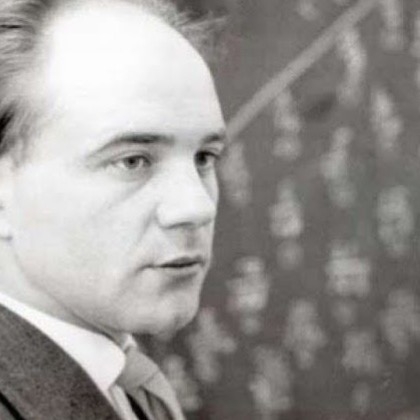
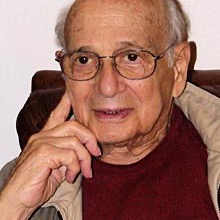
Horst Rittel, Ulm, 1959 (book scan; credit not stated). Melvin M. Webber, c. 2006 (UC Berkeley News; photo Jane Webber). Both cropped square.
For the "Sources" section of brand/design_methodology.md (Qpoint design repo). Compiled 2026-10-20.
How this was verified
- Bibliographic data: Crossref API records (DOI, volume, issue, pages), publisher and library catalogue pages, and the printed title pages and running heads of scanned reprints.
- Quotes marked "verified": read off page images of the scanned original (the IURD reprints on eScholarship reproduce the journal pages, running heads included). Page numbers are the journal's own.
- eScholarship sizes: eScholarship (UC's institutional repository) answers
curl -sILwith a bot challenge (202/403,text/html, length 0). Sizes for eScholarship PDFs are therefore the bytes WebFetch actually received (application/pdf), with page counts frompdfinfo. Every other size is theContent-Lengthfromcurl -sIL. - Open-access status: checked against Unpaywall's API as well as the hosting pages.
- Legitimacy key:
- OPEN (institutional): posted by the issuing institution or its repository. The eScholarship "IURD Reprint/Working Paper Series" items are UC Berkeley's Institute of Urban and Regional Development (the authors' own institute) re-issuing its 1960s–80s offprints. Unpaywall classes them as green OA. The journal copyright still sits with the publisher; the posting is the institution's own.
- PAYWALLED: publisher copy behind a subscription.
- UNCLEAR MIRROR: a third-party or personal re-post of a publisher PDF. Several are JSTOR downloads still showing JSTOR's terms page. Listed so you can recognise them; not recommended.
Contents
Rittel & Webber (core)
- Rittel & Webber (1973), "Dilemmas in a General Theory of Planning", and its reprints
Context (not by Rittel) 2. Churchman (1967), "Wicked Problems" (guest editorial)
Rittel's own work 3. Rittel (1966/1971), "Some Principles for the Design of an Educational System for Design" 4. Rittel (1972), "On the Planning Crisis" 5. Kunz & Rittel (1970), "Issues as Elements of Information Systems" (IBIS), plus Noble & Rittel (1988) 6. Rittel (1972/1984), "Second-generation design methods" 7. Rittel (1987/88), "The Reasoning of Designers" 8. Rittel (1964), The Universe of Design seminars, and Protzen & Harris (2010) 9. Rittel (2013), Thinking Design (German collected essays) 10. Other verified Rittel working papers (1969, 1972, 1982)
Webber's own work 11. Webber (1963), "Order in Diversity: Community without Propinquity" 12. Webber (1963), "Comprehensive Planning and Social Responsibility" 13. Webber (1964), "The Urban Place and the Nonplace Urban Realm" 14. Webber (1968), "The New Urban Planning in America" 15. Webber (1968–69), "Planning in an Environment of Change", Parts I and II (Part II is "Permissive Planning") 16. Webber (1983), "The Myth of Rationality: Development Planning Reconsidered"
The bridge into design (context) 17. Buchanan (1992), "Wicked Problems in Design Thinking" 18. Secondary sources worth knowing
Also: Could not verify · Mirrors to avoid · Notes for design_methodology.md
1. Rittel & Webber (1973), "Dilemmas in a General Theory of Planning"
Citation: Rittel, H. W. J., & Webber, M. M. (1973). Dilemmas in a general theory of planning. Policy Sciences, 4(2), 155–169. https://doi.org/10.1007/BF01405730
- Crossref gives June 1973, Springer.
- The 1973 title page reads "Policy Sciences 4 (1973), 155–169, © Elsevier Scientific Publishing Company, Amsterdam".
- Affiliations: Rittel, "Professor of the Science of Design"; Webber, "Professor of City Planning"; both at UC Berkeley.
- A footnote on p. 155 says the paper modifies one "presented to the Panel on Policy Sciences, American Association for the Advancement of Science, Boston, December 1969."
The co-author's name: Melvin M. Webber, confirmed three ways: Crossref (Melvin M.), the printed 1973 title page ("MELVIN M. WEBBER"), and the 1972 working-paper title page. Mark's thesis gives the initials as "M. W.", which is wrong. Wikipedia's Horst Rittel article has the same error ("Melvin W. Webber"). Fix it to Webber, M. M.
Summary:
- The search for scientific bases for social policy is bound to fail, because planning problems are "wicked" while science grew up on "tame" problems.
- The paper sets out ten properties of wicked problems. Among them:
- no definitive formulation;
- no stopping rule;
- solutions are good or bad, not true or false;
- no ultimate test;
- every attempt counts;
- every problem is unique, and each is a symptom of another;
- the choice of explanation determines the resolution;
- the planner has no right to be wrong.
- It closes on pluralism: there is no undisputable public good, so "optimal solutions" make little sense.
Verified quotes:
- p. 161: "The formulation of a wicked problem is the problem! The process of formulating the problem and of conceiving a solution (or re-solution) are identical, since every specification of the problem is a specification of the direction in which a treatment is considered." This confirms the methodology's p. 161 citation, word for word.
- p. 166 (Proposition 9 heading): "The choice of explanation determines the nature of the problem's resolution." This confirms the methodology's p. 166 citation.
- p. 165 (Proposition 8): "There is nothing like a natural level of a wicked problem."
Relevance:
- This is the primary source for "AI governance is a wicked problem" and "Forming the problem". Both of the methodology's page cites (161, 166) check out.
- Proposition 8 (p. 165) is the paper's warning against decomposition. Treating a problem "on too low a level", or by incrementalism, can make the higher-level problem harder. Worth one line as a guard on our "Decomposition and Modularity" and "Evolution" sections.
Full text:
| Copy | URL | Status | Size, type |
|---|---|---|---|
| Publisher (Springer) | https://link.springer.com/article/10.1007/BF01405730 | PAYWALLED | — |
| IURD Reprint Series (eScholarship): the 1973 journal pages, scanned, 19 pp. | https://escholarship.org/uc/item/5gp9k37h · PDF https://escholarship.org/content/qt5gp9k37h/qt5gp9k37h.pdf | OPEN (institutional). Unpaywall points elsewhere for "green"; this reprint is the version with journal pagination. | 1,335,709 bytes, application/pdf (scan, no text layer) |
| IURD Working Paper No. 194, Nov 1972: pre-publication typescript, 32 pp. | https://escholarship.org/uc/item/01v4t1c9 · PDF https://escholarship.org/content/qt01v4t1c9/qt01v4t1c9.pdf | OPEN (institutional). Unpaywall's "best OA location" for the DOI (green, submitted version). Pagination differs from the journal. | 1,880,484 bytes, application/pdf |
archive.epa.gov rittel+webber+dilemmas+general_theory_of_planning.pdf; www.ars.usda.gov Pol Sci 4p155.pdf (same file) | — | UNCLEAR MIRROR: US-government sites re-posting a Springer article | 1,362,031 bytes, application/pdf |
| urbanpolicy.net | — | UNCLEAR MIRROR | 170,990 bytes, application/pdf |
| cswp.theisrm.org | — | UNCLEAR MIRROR | 1,011,165 bytes, application/pdf |
Reprints:
- Cross (1984), retitled "Planning problems are wicked problems". In N. Cross (Ed.), Developments in Design Methodology (pp. 135–144). Chichester: Wiley. ISBN 0471102482, LCCN 84007433, x + 357 pp.
- Verified: the book record (CiNii, KIT catalogue).
- Partly verified: chapter title and pages. SEBoK gives pp. 135–144, and a scanned table of contents puts it at chapter 2.3, p. 135; that scan is on a piracy site and is not linked here. I saw no publisher table of contents.
- The chapter is an abridged reprint (pp. 135–144 against 15 journal pages), which fits the retitling.
- Full text: no open copy. The Internet Archive does not list the book.
- Reuter & Jonas (2013). "Dilemmas in einer allgemeinen Theorie der Planung / Dilemmas in a General Theory of Planning". In H. W. J. Rittel, Thinking Design (W. D. Reuter & W. Jonas, Eds.), pp. 20–38. Basel: Birkhäuser. https://doi.org/10.1515/9783038210665.20 (Crossref). PAYWALLED.
- Bloomsbury (2016). Rittel & Webber, "Dilemmas in a General Theory of Planning". In Design: Critical and Primary Sources (pp. 89–105). Bloomsbury. https://doi.org/10.5040/9781474282932.0015 (Crossref). PAYWALLED.
2. Churchman (1967), "Wicked Problems" (guest editorial)
Context, not by Rittel.
Citation: Churchman, C. W. (1967). Guest editorial: Wicked problems. Management Science, 14(4), Application Series, B141–B142.
- Verified from the scanned page. Masthead: "MANAGEMENT SCIENCE Vol. 14, No. 4, December, 1967", in the "Free for All" section. Byline: "C. West Churchman, University of California, Berkeley".
- JSTOR stable URL: https://www.jstor.org/stable/2628678
- DOI caveat: 10.1287/mnsc.14.4.B141 is registered for the whole "Free for All" section, pp. B-141–B-146 (Crossref, untitled section). That is why some bibliographies print B141–146. The editorial itself runs B141–B142.
Summary:
- Churchman reports that "Professor Horst Rittel of the University of California Architecture Department" proposed, in a recent seminar, the term "wicked problem" for ill-formulated social-system problems: confusing information, many clients with conflicting values, ramifications throughout the system.
- He then asks whether OR's habit of "taming" such problems is a form of deception, and so a moral question.
- Buchanan (1992, p. 15) calls it "the first published report of Rittel's idea".
Verified quote (p. B141): "Sometimes, as in OR, it consists of 'carving off' a piece of the problem and finding a rational and feasible solution to this piece."
Relevance: the earliest critique of decomposition as taming: solve a carved-off piece and leave "the untamed part" to someone else. It is a useful counterweight to our "Decomposition and Modularity" section. A module's interface has to be drawn so the untamed remainder stays visible, not handed off. Mark's thesis makes the same point (premature over-specification when dividing a problem).
Full text:
| Copy | URL | Status | Size, type |
|---|---|---|---|
| Publisher (INFORMS PubsOnline) | https://pubsonline.informs.org/doi/10.1287/mnsc.14.4.B141 | PAYWALLED (Unpaywall: closed) | — |
| JSTOR | https://www.jstor.org/stable/2628678 | PAYWALLED | — |
punkrockor.com wicked-problems-churchman-1967.pdf: a JSTOR download (accessed 2014) re-posted on a blog | — | UNCLEAR MIRROR | 133,662 bytes, application/pdf |
3. Rittel (1966/1971), "Some Principles for the Design of an Educational System for Design"
Citation, original: Rittel, H. W. J. (1966). Some principles for the design of an educational system for design. In J. R. Passonneau (Ed.), Education for Architectural Technology (pp. 103–151). St. Louis: Washington University / AIA.
- Venue and pages as given in Rith & Dubberly's annotated bibliography. Not checked against the volume.
- IURD issued it as Reprint 54, dated April 1966 (verified, title page).
Citation, journal version: Rittel, H. W. J. (1971). Some principles for the design of an educational system for design. Journal of Architectural Education, 26(1–2), 16–27. https://doi.org/10.1080/10464883.1971.11102482 (Crossref)
Also listed in DMG-DRS Journal 7(2), April 1973, p. 148 (DRS Digital Library contents list).
Summary:
- Rittel sets out what a design education should teach, starting from what designing is.
- Designing is planning for action under uncertainty. The designer relies on "vicarious perception" (models, mock-ups, simulation) to anticipate consequences.
- Design problems are "ill-behaved", and the list of reasons is essentially the later wicked-problem list, here applied directly to design.
Verified quotes (typescript p. 15, Reprint 54):
- "every formulation of the problem is preliminary and incomplete. It changes in the course of solution."
- "Plans are judged as 'good,' 'bad,' 'reasonable,' but never 'correct' or 'false.'"
Relevance:
- The design-specific statement of the wicked-problem properties, seven years before the planning paper.
- It is the best citation for "design problems" (rather than planning problems) being wicked, and for "forming the problem is the problem" as a design claim.
- "Vicarious perception" through mock-ups is exactly what our mocks and demos are ("The demo is the test").
Full text:
| Copy | URL | Status | Size, type |
|---|---|---|---|
| IURD Reprint 54 (eScholarship), 51 pp. typescript | https://escholarship.org/uc/item/65s2n9r1 · PDF https://escholarship.org/content/qt65s2n9r1/qt65s2n9r1.pdf | OPEN (institutional). Unpaywall's green copy for the JAE DOI. | 1,547,006 bytes, application/pdf |
| Journal of Architectural Education (Taylor & Francis) | via DOI | PAYWALLED | — |
4. Rittel (1972), "On the Planning Crisis: Systems Analysis of the 'First and Second Generations'"
Citation: Rittel, H. W. J. (1972). On the planning crisis: Systems analysis of the "first and second generations." Bedriftsøkonomen, (8), 390–396.
- Verified from the scanned journal pages. Running heads read "BEDRIFTSØKONOMEN NR. 8 - 1972", pp. 390 and 396.
- The IURD reprint cover reads "Reprinted from: Bedrifts Økonomen, No. 8, October 1972 (Norway)" and gives the series as "Reprint 107".
- A footnote (in Norwegian) says it was a lecture at a "Systems Analysis Seminar" in Karlsruhe, autumn 1971. The organisers were the European Association of National Productivity Centres and the Studiengruppe für Systemforschung, Heidelberg.
- Dating quirk: eScholarship and the reprint's inner cover say "October 1971". Cite the journal, 1972.
- Reprinted in:
- Protzen & Harris (2010), §2.1;
- Thinking Design (2013), pp. 39–57, https://doi.org/10.1515/9783038210665.39.
Summary:
- Rittel contrasts "first-generation" systems analysis (understand, gather, analyse, generate, assess, implement, test, modify; optimise within a defined solution space) with a "second generation" suited to wicked problems.
- The first generation founders on the "paradoxes of rationality".
- Second-generation principles:
- Symmetry of ignorance: the knowledge needed is distributed among those affected, not held by experts.
- No one wants to be "planned at": involve those affected.
- Transparency and objectification of judgement: make the deontic ("ought-to-be") premises explicit and arguable.
- No scientific planning: dealing with wicked problems "is always political".
Verified quotes:
- p. 394: "every constraint or limitation I pose on my action space is a decision, or at least an implicit indication of resignation."
- p. 394: "The knowledge needed in a planning problem, a wicked problem, is not concentrated in any single head".
Relevance:
- The paper behind "forming the problem is the problem" at the level of process: every constraint is a design decision.
- It is the theoretical root of making reasoning inspectable, which our cycles, plan files, and decisions-and-defaults READMEs do.
- The symmetry of ignorance is the case for archaeology mode: the evidence lives with the people affected (market-analyst's problem registry, customer quotes).
Full text:
| Copy | URL | Status | Size, type |
|---|---|---|---|
| IURD Reprint 107 (eScholarship), 13 pp., scanned journal pages | https://escholarship.org/uc/item/84j908m9 · PDF https://escholarship.org/content/qt84j908m9/qt84j908m9.pdf | OPEN (institutional) | 719,511 bytes, application/pdf (scan, no text layer) |
5. Kunz & Rittel (1970), "Issues as Elements of Information Systems" (IBIS)
Citation: Kunz, W., & Rittel, H. W. J. (1970). Issues as elements of information systems (Working Paper No. 131). Berkeley: Institute of Urban and Regional Development, University of California.
- Corroborating sources:
- Noble & Rittel (1988), bibliography (verified from the scan), which adds "also: Institut fuer Grundlagen der Planung, Universitaet Stuttgart S-78-2";
- Rith & Dubberly's bibliography;
- Thinking Design (2013), pp. 147–153 (https://doi.org/10.1515/9783038210665.147; bilingual title).
- Also in Protzen & Harris (2010), §3.2.
Summary:
- Proposes the Issue-Based Information System (IBIS) for planning groups facing a "problem complex".
- Knowledge is organised around issues (questions), the positions taken on them, and the arguments for and against. This makes the argumentative process of a wicked problem explicit and recordable.
Quote: no open copy of the 1970 paper was found, so no verbatim 1970 quote. From the later restatement, Noble & Rittel (1988), typescript p. 3: "IBIS guides the identification, structuring and resolving of issues raised by designers, and elicits information pertinent to the discourse." (verified)
Relevance:
- The working tool behind "Forming the problem" and "shared language": a problem gains shape as its issues are named and argued.
- It anticipates our decision logs: TODO grammar, decisions-and-defaults, and Mark's thesis call for "an external systemic representation of the problem".
- It is also a precedent for the policy and governance object model (positions and arguments as first-class records).
Full text:
- 1970 Working Paper No. 131: no open copy found. Not on eScholarship under that title; library copies only.
- Related open text: Noble, D., & Rittel, H. W. J. (1988). Issue-based information systems for design (IURD Working Paper). https://escholarship.org/uc/item/4qt7f1vm · PDF https://escholarship.org/content/qt4qt7f1vm/qt4qt7f1vm.pdf · OPEN (institutional), 748,968 bytes, application/pdf, 15 pp.
- It also defines the "symmetry of ignorance" (p. 2, verified): "it is not possible to know who might know something pertinent to a design problem".
- Related, PAYWALLED: Kunz, W., & Rittel, H. W. J. (1972). Information science: On the structure of its problems. Information Storage and Retrieval, 8(2), 95–98. https://doi.org/10.1016/0020-0271(72)90011-3
6. Rittel (1972/1984), "Second-generation design methods"
Citation, as reprinted: Rittel, H. W. J. (1984). Second-generation design methods. In N. Cross (Ed.), Developments in Design Methodology (pp. 317–327). Chichester: Wiley.
- Pages per Wikipedia and secondary bibliographies. Not seen in a publisher table of contents.
Original: an interview, "Son of Rittelthink: The State of the Art in Design Methods". In The DMG 5th Anniversary Report (DMG Occasional Paper No. 1). Berkeley: Design Methods Group, January 1972.
- Report and series confirmed by a library catalogue record (via search); the title is from Rith & Dubberly.
- Rith & Dubberly give "7.2 (1972): 143–147", which conflates this with the DMG-DRS Journal. The DRS Digital Library lists a Rittel entry in the "State of the Art in Design Methods" section of DMG-DRS Journal Vol. 7, No. 2 (April 1973), p. 143. That is probably the reprint of the interview, but I could not open the issue to confirm.
Summary:
- In interview form, Rittel traces the "first generation" of design methods (1960s, systematic and expert-driven, after Archer, Alexander and others) and says why it failed on wicked problems.
- He argues for a "second generation" built on argumentation, participation, the symmetry of ignorance, and transparency of deontic judgement.
- This is the design-methods version of the 1972 Bedriftsøkonomen argument.
Quote: none verified (no legal full text could be opened).
Relevance:
- The bridge from planning to design methodology. It is what Cross's anthology made canonical for designers, and the edition lineage of Mark's thesis citation.
- It supports "Design methodology isn't a process to follow".
Full text:
| Copy | URL | Status | Size, type |
|---|---|---|---|
| DRS Digital Library, DMG-DRS Journal 7(2), whole-issue PDF | https://dl.designresearchsociety.org/dmg-journal/2 · PDF https://dl.designresearchsociety.org/cgi/viewcontent.cgi?article=1001&context=dmg-journal | Appears OPEN: the Design Research Society's own archive. No licence stated. | HEAD blocked (403 to curl and WebFetch); the issue page reports about 10.9 MB |
| Cross (1984) | — | No open copy | — |
7. Rittel (1987/88), "The Reasoning of Designers"
Citation: Rittel, H. W. J. (1988). The reasoning of designers (Arbeitspapier A-88-4). Stuttgart: Institut für Grundlagen der Planung, Universität Stuttgart.
- The series number is from Rith & Dubberly.
- WorldCat OCLC 75157251 (seen via search; the page itself returned 403) describes it as delivered at the International Congress on Planning and Design Theory, Boston, August 1987, and published by IGP Stuttgart in 1988.
- Reprinted in:
- Protzen & Harris (2010), §3.3;
- Thinking Design (2013) as "Die Denkweise von Planern und Entwerfern / The Reasoning of Designers", pp. 123–136, https://doi.org/10.1515/9783038210665.123.
Summary (from secondary descriptions; not read in full):
- Rittel's late synthesis. Designing is reasoning that plans for an unknowable future under value conflict.
- The designer's reasoning is an argumentative, "epistemic freedom" process: there are no logically compelling stopping points, judgements are deontic, and each step could have gone otherwise.
- He calls this the field's core subject, a "science of design".
Quote: none verified.
Relevance:
- The best single Rittel text on how a designer thinks: the methodological core of our "Design Methodology".
- It pairs with Mark's thesis (problem storytelling) and with the 5-question framework, where judgement replaces correctness.
Full text: no open copy found. Published versions are PAYWALLED (Routledge; De Gruyter/Birkhäuser).
8. Rittel (1964), The Universe of Design seminars, and Protzen & Harris (2010)
Citation, the seminars: Rittel, H. W. J. (1964). The universe of design Faculty seminar, College of Environmental Design, Spring 1964. Berkeley: Institute of Urban and Regional Development.
- As listed by Rith & Dubberly. I found no catalogue record or open copy of the 1964 typescript.
Citation, the book: Protzen, J.-P., & Harris, D. J. (2010). The universe of design: Horst Rittel's theories of design and planning. London: Routledge. https://doi.org/10.4324/9780203851586 (Crossref: published 2010-05-06). ISBN 9780415779890; 264 pp.
What the book contains (Routledge contents list):
- Part 1, Foundations. "Reflections on the Scientific and Political Significance of Decision Theory", then the ten Science and Design Seminars (1964).
- Part 2, Wicked Problems. "On the Planning Crisis".
- Part 3, Design Reasoning. "Structure and Usefulness of Planning Information Systems"; "Issues as Elements of Information Systems"; "The Reasoning of Designers".
- Part 4, Consequences of Design. "Technological Change and Urban Structure"; "Pathologies of Planning".
- The editors frame each part with commentary. Protzen was Rittel's Berkeley colleague of some twenty years.
- The ten seminars are: 1 Modes of Innovation; 2 Images and Message; 3 Communications; 4 Establishing Order; 5 Measuring Values and Images; 6 Environments; 7 Design; 8 and 9 Models of and for Design; 10 Conclusion.
- "Dilemmas" itself is not in the book.
Quote: none verified. A secondary quote of Seminar 1 exists on solvingforpattern.org; not checked.
Relevance:
- Rittel's first seminar is titled "Modes of Innovation", the same name as our methodology section (from Mark's 2007 thesis). I can't say whether this is an influence or a coincidence; worth a look before claiming either.
- "Establishing Order" and "Models of and for Design" touch the edge of chaos and problem modelling.
Full text: PAYWALLED (Routledge / Taylor & Francis eBook). The Internet Archive does not list it. Unpaywall: closed.
9. Rittel (2013), Thinking Design (German collected essays)
Citation: Rittel, H. W. J. (2013). Thinking design: Transdisziplinäre Konzepte für Planer und Entwerfer (W. D. Reuter & W. Jonas, Eds.; BIRD series). Basel: Birkhäuser. https://doi.org/10.1515/9783038210665 (Crossref). 368 pp.
- The volume calls itself a new edition of an out-of-print collection ("Vorwort zur Neuauflage"). That earlier collection is presumably Planen, Entwerfen, Design (Reuter, Ed., 1992), but I could not verify it.
Summary:
- Mostly German. Several English originals are given bilingual titles.
- Chapter pages from Crossref:
- Dilemmas, pp. 20–38;
- On the Planning Crisis, pp. 39–57;
- "What is 'the System'?", pp. 58–60;
- "Systematik des Planens", pp. 62–70;
- "Der Planungsprozeß als iterativer Vorgang von Varietätserzeugung und Varietätseinschränkung", pp. 71–86;
- "Über das Messen der Güte von Gebäuden", pp. 87–103;
- "Urteilsbildung und Urteilsrechtfertigung", pp. 104–122;
- The Reasoning of Designers, pp. 123–136;
- Issues as Elements of Information Systems, pp. 147–153;
- Structure and Usefulness of Planning Information Systems, pp. 154–164;
- "How to Know what is Known: Designing Crutches for Communication", pp. 176–184;
- "Instrumentelles Wissen in der Politik", pp. 198–215;
- selected bibliography, pp. 350–354.
Relevance: "The planning process as an iterative process of generating variety and reducing variety" (1970 original, in Joedicke's Arbeitsberichte zur Planungsmethodik 4 per a secondary source; not verified) is Rittel's own statement of our stage rule: generate loosely, then consolidate deliberately. It is the closest Rittel analogue to "the edge of chaos".
Full text: PAYWALLED (De Gruyter; Unpaywall: closed).
10. Other verified Rittel working papers (open)
| Item | Citation | Full text | Size |
|---|---|---|---|
| Decision theory | Rittel, H. W. J. (1969). Reflections on the scientific and political significance of decision theory (IURD Working Paper No. 115). Also Protzen & Harris §1.1. | https://escholarship.org/uc/item/4bq6224m · PDF …/qt4bq6224m/qt4bq6224m.pdf · OPEN (institutional) | 2,088,359 bytes, application/pdf, 36 pp. |
| Instrumental knowledge | Rittel, H. W. J. (1969). Instrumental knowledge in politics (IURD Working Paper No. 116). German original: "Instrumentelles Wissen in der Politik" (1966), in H. Krauch (Ed.), pp. 183–209, per Rith & Dubberly. | https://escholarship.org/uc/item/6hr3x0mc · PDF …/qt6hr3x0mc/qt6hr3x0mc.pdf · OPEN (institutional) | 1,760,248 bytes, application/pdf, 30 pp. |
| Planning information systems | Rittel, H. (1982). Structure and usefulness of planning information systems. In Human and Energy Factors in Urban Planning: A Systems Approach (pp. 53–63). Springer. https://doi.org/10.1007/978-94-009-7651-1_5 | PAYWALLED | — |
The 1969 decision-theory paper is the root of the "deontic premises" argument in item 4: the claim that judgement, not calculation, closes a design decision.
11. Webber (1963), "Order in Diversity: Community without Propinquity"
Citation: Webber, M. M. (1963). Order in diversity: Community without propinquity. In L. Wingo, Jr. (Ed.), Cities and space: The future use of urban land (pp. 23–54 unverified). Baltimore: Johns Hopkins Press for Resources for the Future.
- Book and chapter (chapter 2) verified from the CCA library record and Peter Hall's ACCESS obituary.
- The volume holds essays from the 4th RFF Forum, 1962. A 2013 Routledge reissue exists (ISBN 9781315064598).
Summary:
- Urban communities are increasingly made of interaction networks, not shared territory.
- People belong to many "interest communities" spread across space. Planners' fixation on place (the neighbourhood, the bounded city) mismatches how people actually live.
- So urban order can come from diversity and accessibility, not physical propinquity.
Quote: none verified. A secondary paraphrase, "interaction, not place, is the essence of the city", circulates; I did not confirm it against the text.
Relevance:
- An early networked-system view: the thing that matters is the flows between actors, not their locations. That is Qpoint's own frame (data flows over endpoints) and qmap's actors-and-flows model.
- It shows Webber's habit of questioning the problem's frame: "place" was the wrong formulation.
Full text:
- Internet Archive holds scans of Cities and Space:
citiesspacefut00wing,citiesspacefutur0000lowd,citiesspacefutur0000unse_v6s1(290 images each). - All three are
access-restricted-item: true(print-disabled / lending only). Not open. No other legal copy found.
12. Webber (1963), "Comprehensive Planning and Social Responsibility"
Citation: Webber, M. M. (1963). Comprehensive planning and social responsibility: Toward an AIP consensus on the profession's roles and purposes. Journal of the American Institute of Planners, 29(4), 232–241. https://doi.org/10.1080/01944366308978072 (Crossref)
- Reprinted in A. Faludi (Ed.), A Reader in Planning Theory (1973), pp. 95–112. https://doi.org/10.1016/b978-0-08-017066-4.50011-4
Summary:
- Webber argues that planning's job is to improve the quality of decisions about a plural society's many goals.
- It is not to impose a physical master plan. Planners should expose consequences and serve many publics.
Quote: none verified.
Relevance: the early form of Webber's argument against a single expert-authored "right" plan, half of what became "Dilemmas".
Full text: IURD Working Paper (Nov 1963) on eScholarship: https://escholarship.org/uc/item/2jp6m0f4 · PDF https://escholarship.org/content/qt2jp6m0f4/qt2jp6m0f4.pdf · OPEN (institutional). Unpaywall lists it as the OA copy. 1,081,127 bytes, application/pdf, 15 pp.
13. Webber (1964), "The Urban Place and the Nonplace Urban Realm"
Citation: Webber, M. M. (1964). The urban place and the nonplace urban realm. In M. M. Webber, J. W. Dyckman, D. L. Foley, A. Z. Guttenberg, W. L. C. Wheaton, & C. B. Wurster, Explorations into urban structure (pp. 79–153). Philadelphia: University of Pennsylvania Press. https://doi.org/10.9783/9781512808063-005 (Crossref: chapter, pp. 79–153)
- The co-author list follows the usual catalogue record. I verified Webber as volume editor, and the pages, from Crossref and the ACCESS obituary.
Summary:
- Webber extends "Order in Diversity". He maps urban life as overlapping "realms" of interaction, from the local face-to-face realm up to national and world realms.
- Specialists and firms already live in "nonplace" realms. Urbanity is participation in networks of exchange, not residence in a city, so planning should address interaction systems as well as places.
Quote: none verified.
Relevance: the same networked, flow-first frame as item 11. It is useful as a precedent for organisations whose "territory" is a set of services and vendors, as in qmap's rugs-and-flows model.
Full text:
- Publisher (De Gruyter / Penn Press backlist): PAYWALLED (Unpaywall: closed).
- Internet Archive:
explorationsinto00webb(1971 printing) andexplorationsinto0000unse. Bothaccess-restricted-item: true(lending / print-disabled). Not open.
14. Webber (1968), "The New Urban Planning in America"
Citation: Webber, M. M. (1968). The new urban planning in America. Journal of the Town Planning Institute, 54(1), 3–10.
- The volume, issue and end page are inferred and unverified.
- The scan shows: the address was given at a General Meeting of the Town Planning Institute, 15 November 1967, 26 Portland Place, London; the first page is numbered 3. IURD issued a reprint (1968).
Summary:
- A survey for British planners of how US planning was shifting from physical land-use design to social planning.
- The shift was driven by the "urban crisis", the post-industrial economy, and the separation of the urban (a social system) from the city (a place).
Relevance: context for Webber's turn from physical design to process. Low priority.
Full text: https://escholarship.org/uc/item/86m2v99t · PDF https://escholarship.org/content/qt86m2v99t/qt86m2v99t.pdf · OPEN (institutional). 1,368,617 bytes, application/pdf, 11 pp.
15. Webber (1968–69), "Planning in an Environment of Change" (Part II is "Permissive Planning")
Citations:
- Webber, M. M. (1968). Planning in an environment of change. Part I: Beyond the industrial age. Town Planning Review, 39(3), 179–195. https://doi.org/10.3828/tpr.39.3.l8483lw08g6u235n
- Webber, M. M. (1969). Planning in an environment of change. Part II: Permissive planning. Town Planning Review, 39(4), 277–295. https://doi.org/10.3828/tpr.39.4.c058xp738v338600
How these were verified:
- Volume, issue and start pages: Crossref.
- End pages 195 and 295: page images.
- The reprint cover reads "The Town Planning Review Vol. 39, No. 3 (Oct. 1968); No. 4 (Jan. 1969)".
- IURD issued both parts together as Reprint No. 44.
- A London Centre for Environmental Studies edition, "Beyond the Industrial Age, and; Permissive Planning" (1968), appears in library catalogues.
On "Permissive Planning": it is not a separate paper. It is Part II here, January 1969, TPR 39(4). Wikipedia's "1974 article Permissive Planning" is unverified and probably a reprint or misdating.
On "planning under uncertainty": this two-part paper is Webber's main statement on it.
Summary:
- Part I argues that post-industrial societies (knowledge work, mobility, affluence, pluralism) make the future less predictable and the publics more diverse.
- Part II sets out "the planning idea" as a method:
- explicit goals for each public;
- continuous forecasting of external change and of chains of consequences;
- appraisal of alternatives;
- continuous monitoring with feedback.
- He contrasts this with city planning's inherited design posture. Planning should be "permissive": enabling plural choices rather than imposing one physical order.
Verified quotes:
- p. 195: "The industrial age was dominated by the idea of efficiency. The post-industrial age is likely to be dominated by conflicts over equity."
- p. 295: "As the counterpart of the idea of democracy, and as an instrument for promoting freedom, I suggest it is worth our giving it a try."
Relevance:
- Webber's half of the edge-of-chaos argument: structure (explicit goals, monitoring, feedback) in service of freedom (plural outcomes).
- "Continuous monitoring … fed back into the planning system" is the loop our cycles and capture records run.
- Permissive planning is the planning-scale case for composition over configuration: set protocols, let consumers compose.
Full text:
| Copy | URL | Status | Size, type |
|---|---|---|---|
| IURD Reprint No. 44 (eScholarship), both parts, 45 pp. | https://escholarship.org/uc/item/801866rz · PDF https://escholarship.org/content/qt801866rz/qt801866rz.pdf | OPEN (institutional) | 2,370,730 bytes, application/pdf |
| Town Planning Review (Liverpool University Press) | via DOIs | PAYWALLED | — |
16. Webber (1983), "The Myth of Rationality: Development Planning Reconsidered"
Citation: Webber, M. M. (1983). The myth of rationality: Development planning reconsidered. Environment and Planning B: Planning and Design, 10(1), 89–99. https://doi.org/10.1068/b100089
- Crossref, SAGE and IDEAS/RePEc all agree. Author affiliation: IURD, Berkeley.
Summary (from the abstract):
- The classical rational planning model is "fundamentally flawed". It presumes consensus on goals, causal theory good enough to predict, and effective instrumental knowledge. None of the three holds.
- Centralised planning should be restyled to set the rules for deciding and to foster open debate.
- Substantive strategies, designs and investments should be decentralised, allowing multiple outcomes for plural publics.
Quote: only "fundamentally flawed" (abstract) verified.
Relevance:
- Webber's late restatement of the wicked-problems thesis: central rules plus local composition.
- That is our layer/consumer split. The layer sets protocols and tokens; consumers decide substance. It is the "unified pantry" principle in planning terms.
Full text: PAYWALLED (SAGE; Unpaywall: closed). No open copy found.
17. Buchanan (1992), "Wicked Problems in Design Thinking"
Context: the bridge into design.
Citation: Buchanan, R. (1992). Wicked problems in design thinking. Design Issues, 8(2), 5–21. https://doi.org/10.2307/1511637 (Crossref; JSTOR stable 1511637; MIT Press)
Summary:
- Buchanan recasts design as a liberal art of technological culture, with "placements" as its tool for repositioning problems.
- He argues that Rittel's wicked problems explain why the linear model (problem definition, then problem solution) fails: design problems are fundamentally indeterminate.
- This essay carried "wicked problems" into mainstream design discourse.
Verified quote (p. 15): "The wicked problems approach was formulated by Horst Rittel in the 1960s, when design methodology was a subject of intense interest."
Relevance: the standard citation for wicked problems as a design concept, as opposed to a planning one. Its determinacy/indeterminacy framing matches our "forming the problem is the problem".
Full text:
| Copy | URL | Status | Size, type |
|---|---|---|---|
| JSTOR / MIT Press | https://www.jstor.org/stable/1511637 | PAYWALLED | — |
| Spanish translation, Revista KEPES (Universidad de Caldas), 2010, pp. 7–35 | https://revistasojs.ucaldas.edu.co/index.php/kepes/article/view/477 | Unpaywall: green, CC-BY. Legitimately open, but a translation. | not HEAD-checked |
web.mit.edu/jrankin Design_thinking.pdf: a JSTOR download on an MIT instructor's course page | — | UNCLEAR MIRROR (course reserve) | 466,091 bytes, application/pdf |
18. Secondary sources worth knowing
- Rith, C., & Dubberly, H. (2007). Why Horst W. J. Rittel matters. Design Issues, 23(1).
- Includes an annotated bibliography and the 1992 UC memorial by Churchman, Protzen and Webber.
- Author-hosted at https://www.dubberly.com/articles/why-horst-wj-rittel-matters.html (HTML) and https://courses.dubberly.com/design_theory/12._Why_Horst_W._J._Rittel_Matters.pdf (152,090 bytes, application/pdf).
- Status: the author's own site; appears legitimately self-archived.
- Caution: its "Dilemmas" entry misattributes the venue ("Panel on Policy Sciences, AAAS 4 (1969): 155–169"). Use it for the annotations, not for citation details.
- Crowley, K., & Head, B. W. (2017). The enduring challenge of "wicked problems": Revisiting Rittel and Webber. Policy Sciences, 50, 539–547. https://doi.org/10.1007/s11077-017-9302-4
- Unpaywall: green, CC-BY submitted version on figshare. The page returned 403 to fetch, so not HEAD-checked.
- Hall, P. "Melvin M. Webber: Maker and Breaker of Planning Paradigms." ACCESS (UC Transportation Center), obituary essay. https://accessmagazine.org/special-issue/melvin-m-webber-maker-and-breaker-of-planning-paradigms/ (open web page)
- Confirms the 1963 and 1964 essays, the two-part TPR paper, Milton Keynes, and The BART Experience (1976).
Full texts
Local copies of the open full texts by Rittel and Webber, downloaded on 2026-10-20 from their institutional or author hosts. Sizes match the hosts. The other entries are paywalled, library-only, or of unclear posting rights, so they are given as links only.
| File | Work | Host | Pages |
|---|---|---|---|
| rittel-webber-1973-dilemmas.pdf | Rittel & Webber (1973), "Dilemmas in a General Theory of Planning", journal pages | UC eScholarship, IURD Reprint | 19 |
| rittel-webber-1972-dilemmas-wp194.pdf | The same, Working Paper 194 typescript (Nov 1972) | UC eScholarship | 32 |
| rittel-1966-some-principles-design-education.pdf | Rittel (1966/1971), "Some Principles for the Design of an Educational System for Design" | UC eScholarship | 51 |
| rittel-1972-planning-crisis.pdf | Rittel (1972), "On the Planning Crisis: Systems Analysis of the 'First and Second Generations'" | UC eScholarship | 13 |
| noble-rittel-1988-ibis-for-design.pdf | Noble & Rittel (1988), "Issue-Based Information Systems for Design" | UC eScholarship | 15 |
| rittel-1969-wp115-decision-theory.pdf | Rittel (1969), "Reflections on the Scientific and Political Significance of Decision Theory" (WP 115) | UC eScholarship | 36 |
| rittel-1969-wp116-instrumental-knowledge-politics.pdf | Rittel (1969), "Instrumental Knowledge in Politics" (WP 116) | UC eScholarship | 30 |
| webber-1968-planning-environment-of-change.pdf | Webber (1968–69), "Planning in an Environment of Change", Parts I–II (II = "Permissive Planning") | UC eScholarship | 45 |
| webber-1963-comprehensive-planning-social-responsibility.pdf | Webber (1963), "Comprehensive Planning and Social Responsibility" | UC eScholarship | 15 |
| webber-1968-new-urban-planning-america.pdf | Webber (1968), "The New Urban Planning in America" | UC eScholarship | 11 |
Could not verify
- Cross (1984) chapter details: "Planning problems are wicked problems", pp. 135–144, and "Second-generation design methods", pp. 317–327. Only secondary sources and a pirate-hosted table-of-contents scan support them. The book record itself (Wiley 1984, ISBN 0471102482, x + 357 pp.) is verified. Check a physical copy or the LoC record (LCCN 84007433).
- "Son of Rittelthink" title and pages, and whether DMG-DRS Journal 7(2):143 is the same text. The DRS PDF was blocked.
- Kunz & Rittel (1970) full text: no open copy. The citation details are verified via Noble & Rittel (1988).
- "The Reasoning of Designers" (1988): Arbeitspapier number A-88-4 rests on a single source (Rith & Dubberly). The WorldCat page was blocked.
- The 1964 Universe of Design IURD typescript: cited by Rith & Dubberly; no catalogue record or copy found. The seminar titles are verified via Routledge's contents list.
- Webber, "Order in Diversity": page range (23–54 is commonly cited) and any verbatim quote.
- Webber, "Permissive Planning" as a 1974 article (Wikipedia). Only the 1969 TPR Part II is verified.
- Webber, "A Difference Paradigm for Planning" (often cited as 1978, in R. W. Burchell & G. Sternlieb (Eds.), Planning Theory in the 1980s, Rutgers CUPR). Only a CCA library contents line confirms the title. Venue, year and pages are unverified.
- Webber (1968), J. Town Planning Institute 54(1), 3–10: volume, issue and end page.
- Rittel (1966) in Passonneau (Ed.), pp. 103–151: from Rith & Dubberly only.
- Rittel, "Der Planungsprozess als iterativer Vorgang…" (1970), Joedicke's Arbeitsberichte zur Planungsmethodik 4: secondary only. The 2013 reprint, pp. 71–86, is verified.
- Rittel's "Thinking design" and "The universe of design" as separate lecture series: "Thinking Design" is the 2013 German collection, not a lecture series. "The Universe of Design" is the 1964 seminar series, published in Protzen & Harris (2010).
Mirrors to avoid (found, not recommended)
archive.epa.gov and www.ars.usda.gov copies of "Dilemmas" (1,362,031 bytes); urbanpolicy.net (170,990); cswp.theisrm.org (1,011,165); punkrockor.com Churchman (133,662, a JSTOR download); web.mit.edu/jrankin Buchanan (466,091, a JSTOR download); pdfcoffee.com (Cross 1984 scan); ftp.isdi.co.cu (Design Issues and Rittel mirrors); papers.mewayz.com.
Notes for design_methodology.md
- Both page cites in the current Sources line are correct (p. 161, p. 166, Policy Sciences 4(2), 155–169).
- Add Webber, M. M. to any copy of the thesis bibliography that is reproduced; the thesis has "M. W.".
- Option: cite Rittel (1966/1971), "Some Principles…", for "design problems are ill-behaved". It is the design-specific source; "Dilemmas" is about planning.
- Option: cite Churchman (1967) and Proposition 8 (p. 165) as the counterweight in "Decomposition and Modularity".
- Option: note the shared name with Rittel's 1964 seminar "Modes of Innovation" after checking Protzen & Harris (2010).