brand/foundational/sources/levin.md
Sources: Michael Levin
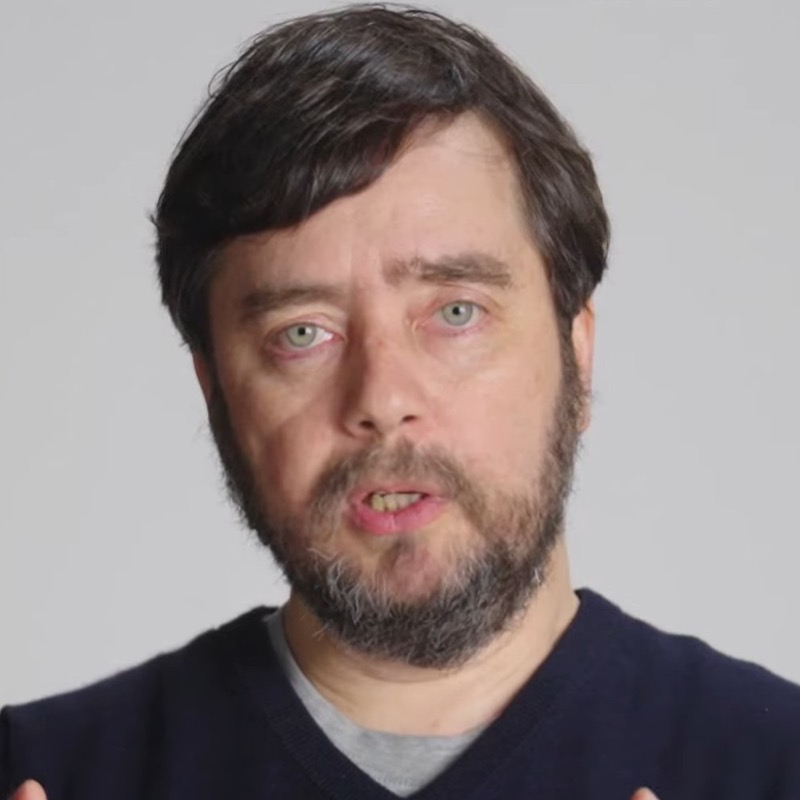
Photo: John Templeton Foundation, 5 Mar 2024, CC BY 3.0, via Wikimedia Commons. Cropped square.

Michael Levin is a developmental and synthetic biologist at Tufts University: Vannevar Bush Distinguished Professor of Biology, leader of the Allen Discovery Center at Tufts, and associate faculty at Harvard's Wyss Institute. His work treats bioelectric signalling as the medium by which groups of cells decide what shape to build, and argues that goal-directed problem-solving appears at every scale of biology, from molecular networks to whole organisms and to new living forms built in the lab. This page lists his key conceptual works and where each can be read. Each citation is checked against Crossref and PubMed; full texts are open-access journal, PMC or preprint-server copies. Compiled 2026-10-20.
Books
- Levin, M., & Adams, D. S. (Eds.) (2016). Ahead of the Curve: Hidden Breakthroughs in the Biosciences. IOP Publishing. doi:10.1088/978-0-7503-1326-1. An edited collection that reprints overlooked biology papers that run against the prevailing paradigm, each with commentary from a current researcher. In copyright, with no open copy.
No sole-authored or trade book by Levin was found, published or forthcoming.
Papers
In date order. Each entry says what the work argues.
| Work | Full text | Local copy |
|---|---|---|
| Pezzulo, G., & Levin, M. (2016). "Top-down models in biology: explanation and control of complex living systems above the molecular level." Journal of the Royal Society Interface 13(124), 20160555. doi:10.1098/rsif.2016.0555. Argues that biology should borrow higher-level, goal-based models from physics, control theory and neuroscience instead of relying only on molecular explanation. Large-scale anatomy can be understood and steered as a system that works toward a target shape. | PMC5134011 (open) | none |
| Levin, M. (2019). "The Computational Boundary of a 'Self': Developmental Bioelectricity Drives Multicellularity and Scale-Free Cognition." Frontiers in Psychology 10, 2688. doi:10.3389/fpsyg.2019.02688. Defines an individual by the size of the goals it can pursue. Any self is bounded by the events it can measure, model and try to affect: "a cognitive 'light cone' which defines the scale and limits of its cognition". Bioelectric networks let cells merge into larger selves with larger goals. | frontiersin.org (open); PMC6923654 | none |
| Kriegman, S., Blackiston, D., Levin, M., & Bongard, J. (2020). "A scalable pipeline for designing reconfigurable organisms." PNAS 117(4), 1853–1859. doi:10.1073/pnas.1910837117. The first xenobots. An evolutionary algorithm designs body shapes in simulation; the designs are then built from frog skin and heart-muscle cells, and the living versions show the predicted behaviours. | PMC6994979 (open) | none |
| Levin, M., & Dennett, D. C. (2020). "Cognition all the way down." Aeon, 13 Oct 2020. An essay arguing that biologists should treat cells, tissues and organisms as "agents with agendas (even if unthinking ones)". Cognition is presented as a continuum that grew gradually out of cells sharing and merging their internal states. | aeon.co (open web) | none |
| Levin, M. (2021). "Life, death, and self: Fundamental questions of primitive cognition viewed through the lens of body plasticity and synthetic organisms." Biochemical and Biophysical Research Communications 564, 114–133. doi:10.1016/j.bbrc.2020.10.077. Uses regeneration, chimeras and biobots to argue that body, organism, lineage, death and memory are less well defined than usually assumed. The boundaries of bodily and cognitive selves are fluid. | Paywalled; abstract at PubMed 33162026 | none |
| Bongard, J., & Levin, M. (2021). "Living Things Are Not (20th Century) Machines: Updating Mechanism Metaphors in Light of the Modern Science of Machine Behavior." Frontiers in Ecology and Evolution 9, 650726. doi:10.3389/fevo.2021.650726. Argues that the debate over whether organisms are machines rests on an outdated idea of a machine. Terms such as machine, robot, program, evolved and designed need redefining for a future in which evolved and designed systems have no sharp boundary. | frontiersin.org (open, CC BY) | none |
| Levin, M. (2021). "Bioelectric signaling: Reprogrammable circuits underlying embryogenesis, regeneration, and cancer." Cell 184(8), 1971–1989. doi:10.1016/j.cell.2021.02.034. A review of how voltage patterns across tissues, set by ion channels and gap junctions, carry information that coordinates cells toward large-scale anatomy. These circuits can be rewritten, which points to interventions in birth defects, regeneration and cancer. | Free to read at Cell (publisher; no reuse licence); not in PMC | none |
| Kriegman, S., Blackiston, D., Levin, M., & Bongard, J. (2021). "Kinematic self-replication in reconfigurable organisms." PNAS 118(49), e2112672118. doi:10.1073/pnas.2112672118. Xenobots gather loose cells in their surroundings into copies of themselves, a form of replication not seen in any known organism. AI-designed body shapes keep the cycle going for more generations. | PMC8670470 (open) | none |
| Levin, M. (2022). "Technological Approach to Mind Everywhere: An Experimentally-Grounded Framework for Understanding Diverse Bodies and Minds." Frontiers in Systems Neuroscience 16, 768201. doi:10.3389/fnsys.2022.768201. Introduces TAME, a framework for recognising and comparing cognition in any substrate, evolved or engineered. Agency is treated as continuous, not binary, and is measured by experiment. Morphogenesis is read as a form of basal cognition, and bodies are described as a multiscale competency architecture. A PsyArXiv preprint dates from Dec 2021. | frontiersin.org (open); PMC8988303 | none |
| Fields, C., & Levin, M. (2022). "Competency in Navigating Arbitrary Spaces as an Invariant for Analyzing Cognition in Diverse Embodiments." Entropy 24(6), 819. doi:10.3390/e24060819. Proposes competent navigation of a problem space (metabolic, transcriptional, anatomical or three-dimensional) as a common yardstick for intelligence. People recognise intelligence in familiar behaviour and miss it in unfamiliar forms. | mdpi.com (open); PMC9222757 | none |
| Levin, M. (2023). "Darwin's agential materials: evolutionary implications of multiscale competency in developmental biology." Cellular and Molecular Life Sciences 80(6), 142. doi:10.1007/s00018-023-04790-z. Evolution works with cells that are not passive parts but problem-solvers in their own right. Because cells, tissues and organs can correct for perturbations and still reach their goals, evolution searches faster and more robustly than it otherwise would. | PMC10167196 (open) | none |
| Levin, M. (2023). "Bioelectric networks: the cognitive glue enabling evolutionary scaling from physiology to mind." Animal Cognition 26(6), 1865–1891. doi:10.1007/s10071-023-01780-3. Argues that all intelligence is collective intelligence. Bioelectric signalling bound cells into bodies long before neurons existed, and evolution later repurposed the same machinery from navigating anatomical shape to navigating three-dimensional space as behaviour. | PMC10770221 (open) | none |
| Gumuskaya, G., Srivastava, P., Cooper, B. G., Lesser, H., Semegran, B., Garnier, S., & Levin, M. (2024). "Motile Living Biobots Self-Construct from Adult Human Somatic Progenitor Seed Cells." Advanced Science 11(4), 2303575 (online 30 Nov 2023). doi:10.1002/advs.202303575. Introduces anthrobots: each grows from a single adult human airway cell, with no genetic editing, into a motile multicellular body. Their body shapes predict how they move, and in culture they prompt repair of scratched neural tissue. | PMC10811512 (open) | none |
| Levin, M. (2024). "Self-Improvising Memory: A Perspective on Memories as Agential, Dynamically Reinterpreting Cognitive Glue." Entropy 26(6), 481. doi:10.3390/e26060481. Treats memory as "preserving salience, not fidelity". Agents keep reinterpreting their own past records to fit a changing self, and the paper speculates that memories may themselves act as agents. | mdpi.com (open); PMC11203334 | none |
| Chis-Ciure, R., & Levin, M. (2025). "Cognition all the way down 2.0: neuroscience beyond neurons in the diverse intelligence era." Synthese 206(5), 257. doi:10.1007/s11229-025-05319-6. Defines intelligence as search efficiency: how much less work an agent spends reaching a goal than a random search would. Applying the measure to amoebae and regenerating planaria shows that "simple" organisms are orders of magnitude better than chance. | link.springer.com (open, CC BY) | none |
| Levin, M. (2025–26). "Ingressing Minds: Causal Patterns Beyond Genetics and Environment in Natural, Synthetic, and Hybrid Embodiments." PsyArXiv preprint, doi:10.31234/osf.io/5g2xj (v2 Feb 2025; v4 June 2026). Not peer-reviewed. Proposes a structured latent space of patterns, in the Platonist sense, that shapes engineered and evolved beings alike. Minds sit on a spectrum with mathematical truths, and the mind–body relationship mirrors that between mathematical facts and physics. | osf.io (open, CC BY) | none |
Talks and interviews
- Lex Fridman Podcast #325, "Michael Levin: Biology, Life, Aliens, Evolution, Embryogenesis & Xenobots" (1 Oct 2022): https://lexfridman.com/michael-levin/
- Lex Fridman Podcast #486, "Michael Levin: Hidden Reality of Alien Intelligence & Biological Life" (30 Nov 2025): https://lexfridman.com/michael-levin-2/. Transcript: https://lexfridman.com/michael-levin-2-transcript
- Sean Carroll's Mindscape, episode 132, "Michael Levin on Growth, Form, Information, and the Self" (1 Feb 2021), with transcript: https://www.preposterousuniverse.com/podcast/2021/02/01/132-michael-levin-on-growth-form-information-and-the-self/
- The Tim Ferriss Show #849, "Dr. Michael Levin — Reprogramming Bioelectricity, Updating 'Software' for Anti-Aging, Treating Cancer Without Drugs, Cognition of Cells, and Much More" (21 Jan 2026): https://tim.blog/2026/01/21/dr-michael-levin/. Transcript: https://tim.blog/2026/01/21/dr-michael-levin-transcript/
- American Institute of Physics oral history, interviewed by David Zierler (29 June 2020). It covers his childhood in Moscow through his bioelectricity work. The 56-page transcript is restricted to approved researchers: https://doi.org/10.1063/nbla.ocge.vmcx
- His lab keeps a list of recorded talks and interviews: https://drmichaellevin.org/presentations/audiovideo.html
About him
- Levin Lab: https://drmichaellevin.org/ (publications list at https://drmichaellevin.org/publications/)
- Allen Discovery Center at Tufts: https://allencenter.tufts.edu/
- Tufts Biology profile: https://as.tufts.edu/biology/node/86191; full Tufts profile: https://facultyprofiles.tufts.edu/michael-levin-1
- Wyss Institute associate faculty profile: https://wyss.harvard.edu/team/associate-faculty/michael-levin-ph-d/
- Google Scholar: https://scholar.google.com/citations?user=luouyakAAAAJ
- Blog, Forms of life, forms of mind (WordPress, not Substack; posts since Oct 2023): https://thoughtforms.life/
- Wikipedia (secondary): https://en.wikipedia.org/wiki/Michael_Levin_(biologist)
Name check: a different Michael Levin, a philosopher at City College of New York, turns up in library and book-review records. His works are not listed here.
Could not verify
- Ahead of the Curve, Volume 2 (2018). Levin's lab page lists a second volume, and one library catalogue gives 2018. No IOP record or DOI was found, so it is left out of Books.
- A forthcoming book. No announced title, publisher or date was found.
- The Ingressing Minds venue. One secondary source says it is meant for an anthology from the "Metaphysics and the Matter With Things" project. That is unconfirmed; it is listed only as a preprint.
- Theories of Everything (Curt Jaimungal). Levin has several long episodes there (2024–25, including one with Anil Seth). Their dates and numbers come only from podcast aggregators and were not checked against the show, so they are not listed.
- AIP oral history date. Wikipedia gives 24 Sep 2021, but AIP's own record says 29 June 2020. AIP's date is used above.