← Resources & Sources
brand/foundational/sources/deutsch-popper.md
Sources: David Deutsch and Karl Popper
Contents
The works behind c117's error-correction thread. Page-level quotes, summaries at three lengths and the "Do not use" misquote list are in the c117 research file 02: David Deutsch and Karl Popper. This page lists the works and where each can be read. Compiled 2026-10-20.
David Deutsch
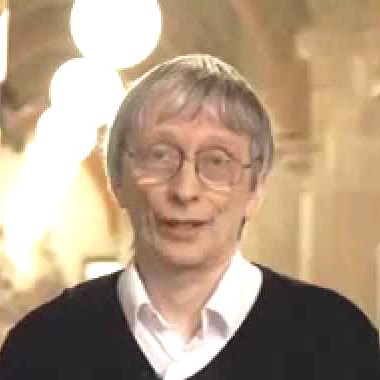
Photo: Simon Benjamin, 2015, video still, CC BY 3.0, via Wikimedia Commons. Cropped square.

Books
- Deutsch, D. (1997). The Fabric of Reality. Allen Lane. Includes the four-stage account of problem-solving (ch. 3). Problems are conjectural too: "the initiating problem itself is not immutable."
- Deutsch, D. (2011). The Beginning of Infinity: Explanations That Transform the World. Allen Lane. Introduces good explanations as "hard to vary", the principle that problems are soluble, and error correction as the engine of progress. Also covers static vs dynamic societies.
Both are in copyright, with no open copy.
Papers and essays
| Work | Full text | Local copy |
|---|---|---|
| "Creative blocks" (How close are we to creating artificial intelligence?), Aeon, 3 Oct 2012 | aeon.co (open web) | none |
| "Constructor Theory", Synthese 190 (2013); arXiv 2012 | arXiv:1210.7439 (open) | deutsch-2013-constructor-theory-arxiv.pdf (40 pp) |
| "Beyond Reward and Punishment", in J. Brockman (Ed.), Possible Minds (Penguin, 2019) | author PDF, daviddeutsch.org.uk | deutsch-2019-beyond-reward-and-punishment.pdf (8 pp) |
| Marletto, C. "Constructor theory of life" (2015). Context; not by Deutsch. | arXiv:1407.0681 (open) | none |
Interviews (transcripts)
- Naval Ravikant, "The Deutsch Files I" (11 Jan 2024): https://nav.al/deutsch-files-i
- Joseph Walker, episode 153, Deutsch and Pinker (20 Dec 2023): https://josephnoelwalker.com/153-deutsch-pinker-dialogue/
- Dwarkesh Patel, episode 21 (31 Jan 2022): https://www.dwarkesh.com/p/david-deutsch
- TNO interview on AI (27 Sep 2022): https://www.tno.nl/en/newsroom/insights/2022/09/david-deutsch-development-application-ai/
About him
- Personal site: https://daviddeutsch.org.uk/
- Oxford Physics, on his Breakthrough Prize: https://www.physics.ox.ac.uk/news/professor-david-deutsch-awarded-breakthrough-prize
Karl Popper
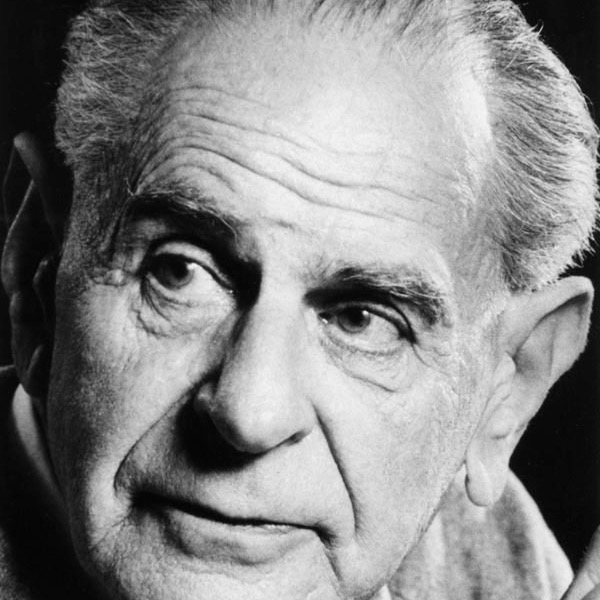
Photo: Franz Barta, c. 1980, LSE Library, no known copyright restrictions, via Wikimedia Commons. Cropped square.

All in copyright, with no open copies.
| Work | Why it's here |
|---|---|
| Logik der Forschung (1934); The Logic of Scientific Discovery (1959) | Falsifiability and demarcation. Inquiry "is, in principle, without end" (§11). Rittel & Webber cite this book (1961 edition) in proposition 10. |
| The Open Society and Its Enemies (1945), 2 vols. | Piecemeal vs utopian social engineering. Change one institution at a time so mistakes stay correctable. The paradox of tolerance is in a footnote, and its second half is usually cut. |
| The Poverty of Historicism (1957) | Against laws of historical destiny. |
| Conjectures and Refutations (1963) | Knowledge grows by conjecture and criticism: "we can learn from our mistakes". |
| Objective Knowledge: An Evolutionary Approach (1972; rev. 1979) | The tetradic schema P1 → TT → EE → P2 (pp. 119, 144, 164, 177, 243–4). We come to know a problem by producing an inadequate solution and criticising it (pp. 260–1). World 3. Searchlight vs bucket. |
| Unended Quest: An Intellectual Autobiography (1976) | A problem may at first be "just 'felt'". The first problems and first theories "arose together". |
| The Myth of the Framework (1994) | Critical discussion across frameworks. |
| All Life Is Problem Solving (1999; German 1994) | Late essays; the title is his thesis. |
Framing (secondary): Stephen Thornton, "Karl Popper", Stanford Encyclopedia of Philosophy: https://plato.stanford.edu/entries/popper/