Design Methodology
Why
Qpoint's brand already embodies many of the principles Mark articulated in his 2007 master's thesis Looking In: An Examination of Design as Method — but that intellectual lineage has never been made explicit. The thesis examines how designers systematically address wicked problems: through decomposition into modular patterns, shared representations that enable collective innovation, and the understanding that design is assemblage of meaning-laden pieces rather than creation from nothing.
These ideas have fresh urgency in 2026. AI agents face the exact problems the thesis describes: how to coordinate multiple specialists (human + agent) on wicked problems without destroying innovation through overspecification; how to maintain shared consciousness across a team that can't hold the whole problem in one mind; how to balance freedom and structure at "the edge of chaos." Qpoint itself — a system that makes the invisible visible and the uncontrolled controllable — is a design solution to a wicked problem.
This cycle maps the thesis's core ideas to Qpoint's brand identity, design system practice, and product philosophy, then proposes concrete ways to weave them in.
Scope
Phase 1 — Brand Foundation (Tier 1)
- Update
brand/component_philosophy.md— add a "Design Lineage" section connecting the seven principles to the methodological framework - Update
brand/qpoint_brand_foundation_v1.5.md— add a "Design Methodology" section articulating the wicked-problem framing - New file:
brand/design_methodology.md— standalone document capturing the full thesis-to-Qpoint mapping, referenced by foundation, available via MCP
Phase 2 — Design Site Page (Tier 2)
- New page:
/method— designed presentation of these ideas in Qpoint's visual language - Not a thesis summary — a Qpoint-specific articulation of design methodology as practiced
Phase 3 — MCP + Agent Integration (Tier 3)
- New MCP resource:
brand://qpoint/method - Update brand voice guidelines with the "forming the problem" concept
Phase 4 — Marketing Language (Tier 4)
- Positioning language using the wicked-problem framing
- Design process narrative told through the five phases
Outcome — Phase 1
New file: brand/design_methodology.md
Standalone document (~1,800 words) mapping the thesis's core ideas to Qpoint's practice. Six sections:
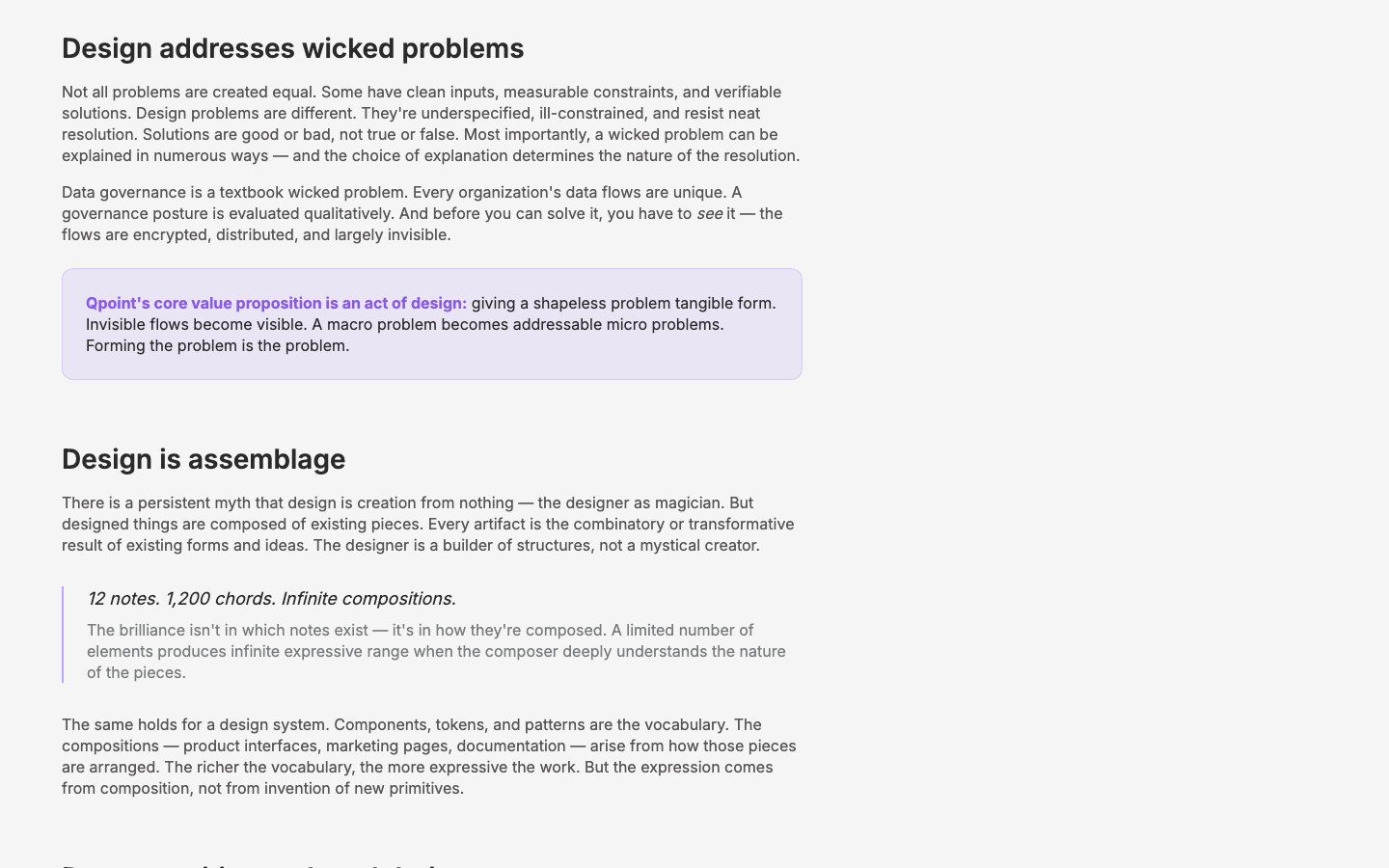
- Design Addresses Wicked Problems — data governance as wicked problem, Qpoint as the act of giving it form
- Design Is Assemblage — innovation through composition of existing pieces, not creation from nothing; music/component vocabulary analogy
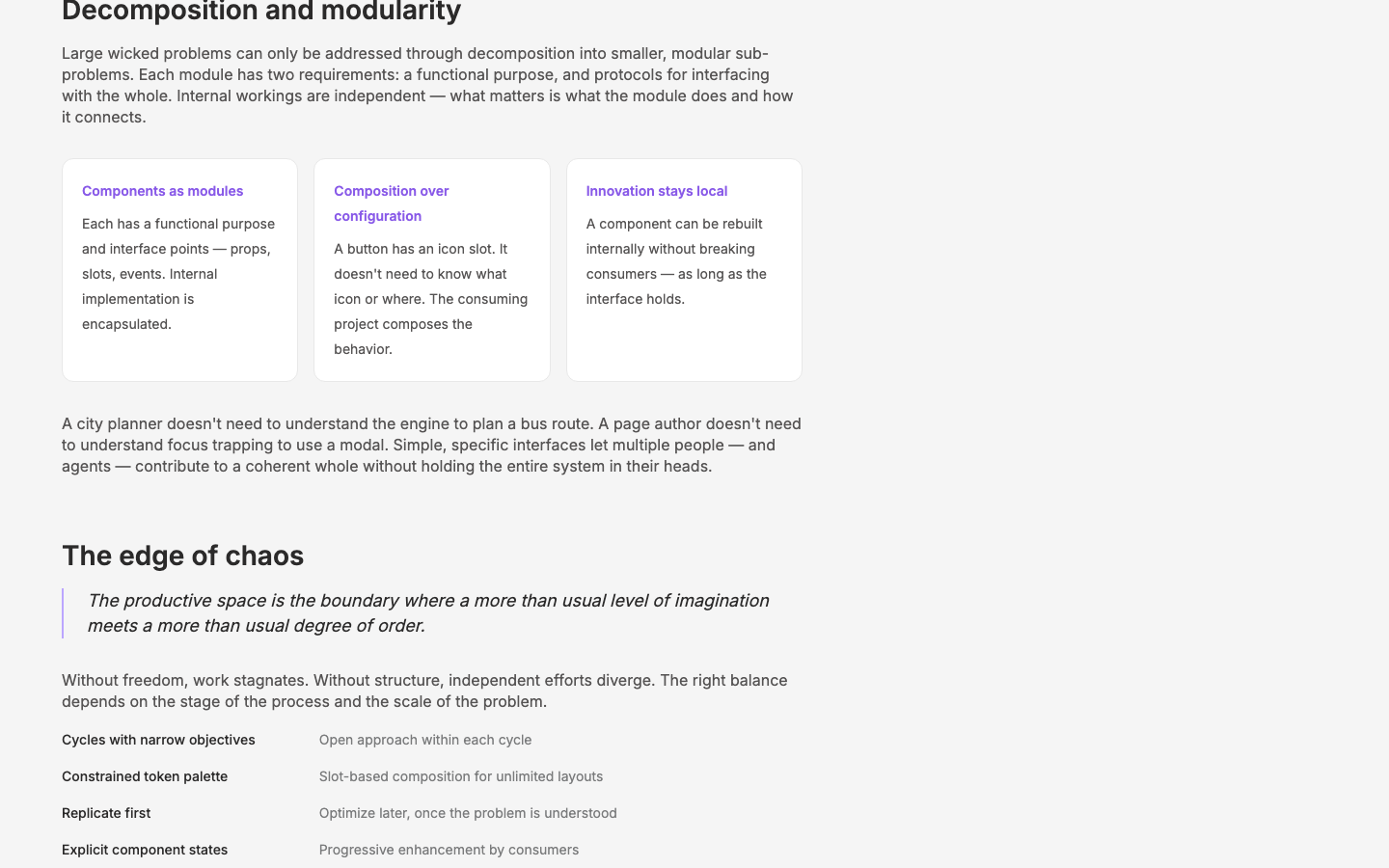
- Decomposition and Modularity — modules with functional purpose and clear interfaces; bus analogy applied to component library
- The Edge of Chaos — the productive tension between freedom and structure; how cycles, replicate-first, and tokens navigate it
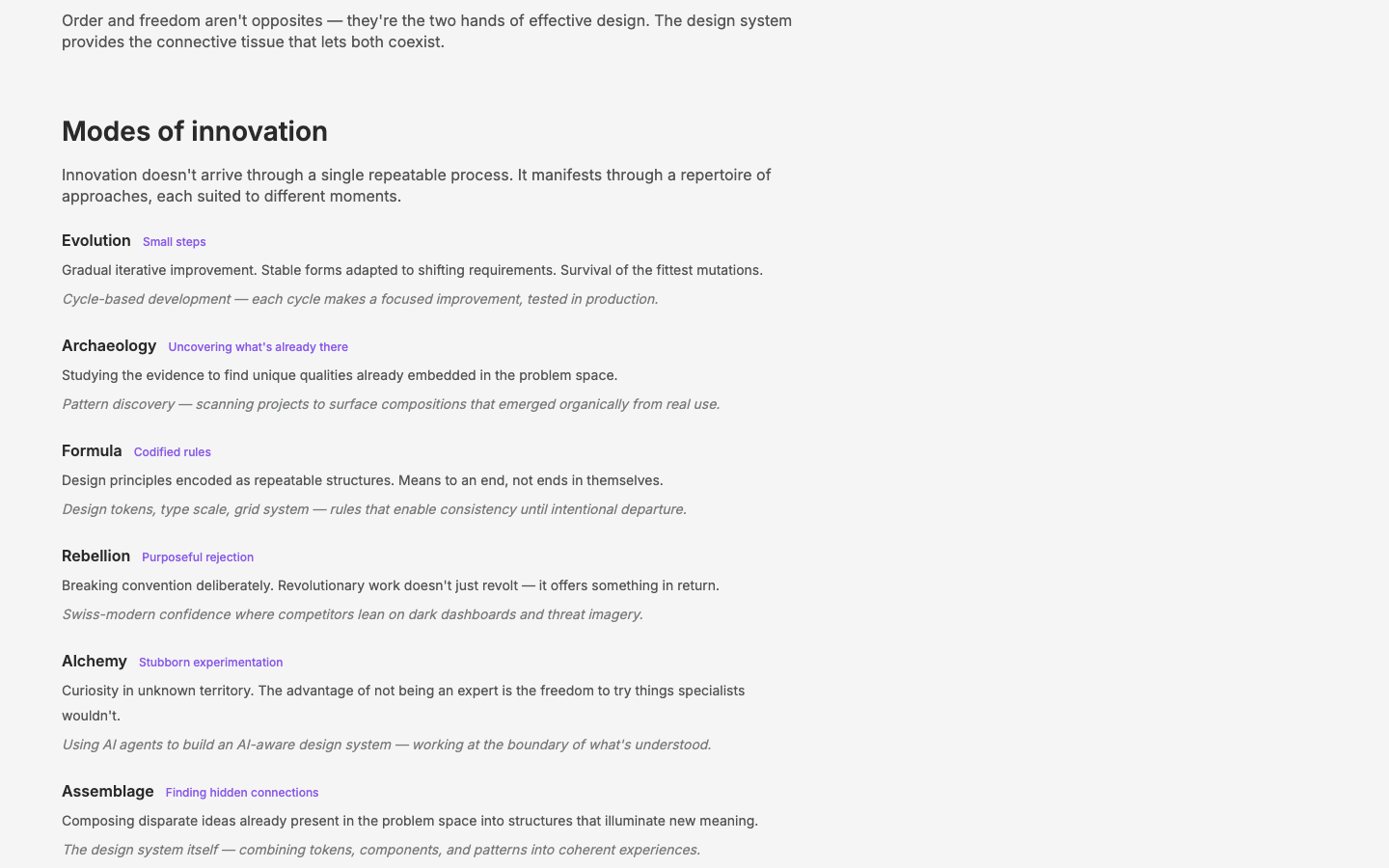
- Modes of Innovation — seven approaches (evolution, archaeology, formula, rebellion, alchemy, farce, assemblage) mapped to Qpoint practice
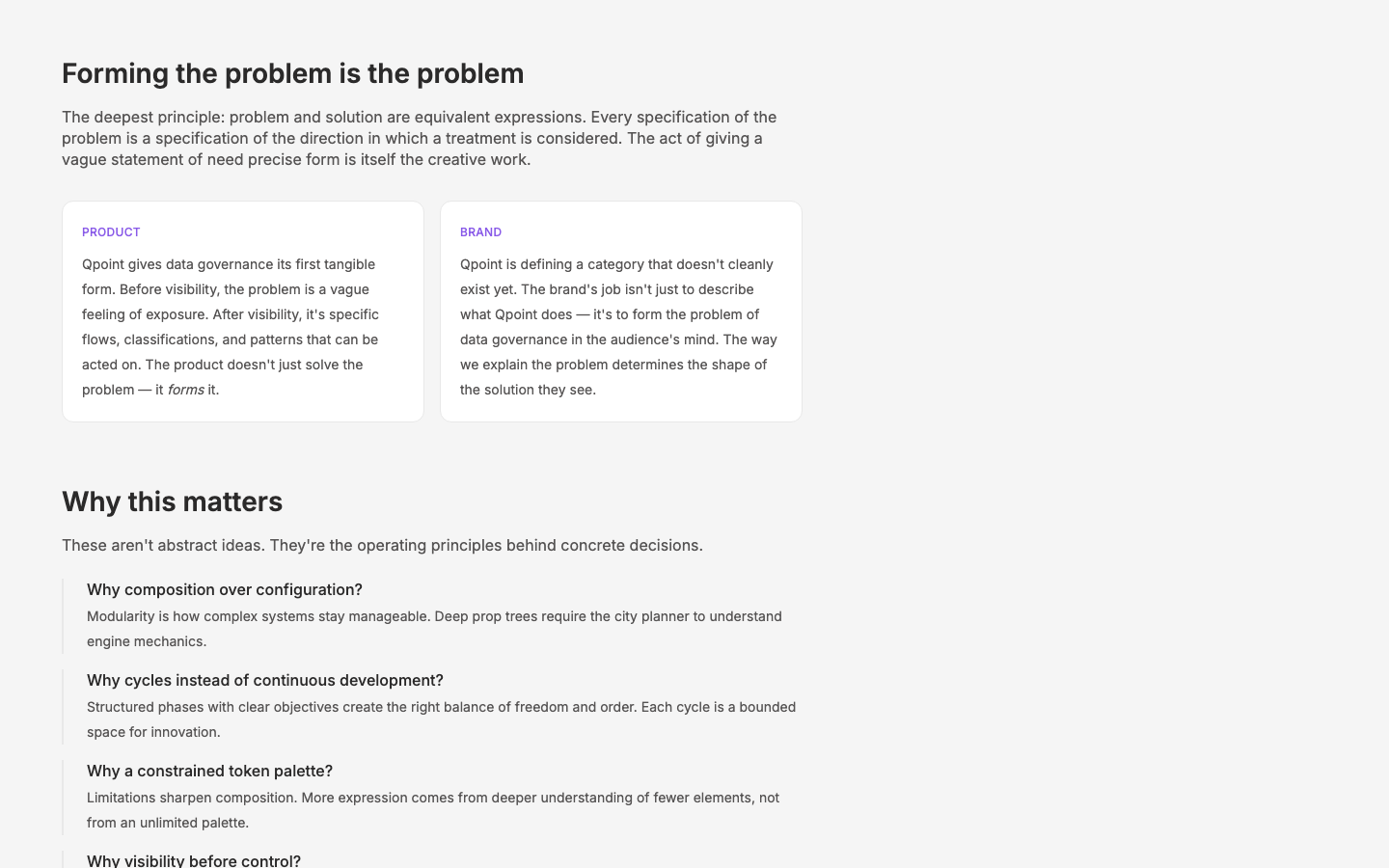
- Forming the Problem — problem/solution equivalency applied to both product (visibility) and brand (category creation)
Voice is absorbed — no academic citations, occasional casual reference to the intellectual lineage. Agent-era connections (collective sketching, shared consciousness) are present as internal framing but not positioned as external messaging.
Updated: brand/component_philosophy.md
Added "Design Lineage" section between Principles and Naming. Connects the seven component principles to the methodological framework: decomposition (principles 1, 6), modularity (principle 2), assemblage (principle 4), problem formulation (principle 7), and the edge of chaos (the palette/slot tension). Cross-references design_methodology.md.
Updated: brand/qpoint_brand_foundation_v1.5.md
Added section 07 "Design Methodology" between What We Are Not and Guiding Principles for AI Agents. Four subsections: Forming the Problem, Design Is Assemblage, Modularity Enables Scale, Freedom and Structure Coexist. Renumbered sections 08–11. Cross-references design_methodology.md.
Outcome — Phase 2
New page: app/pages/method.vue
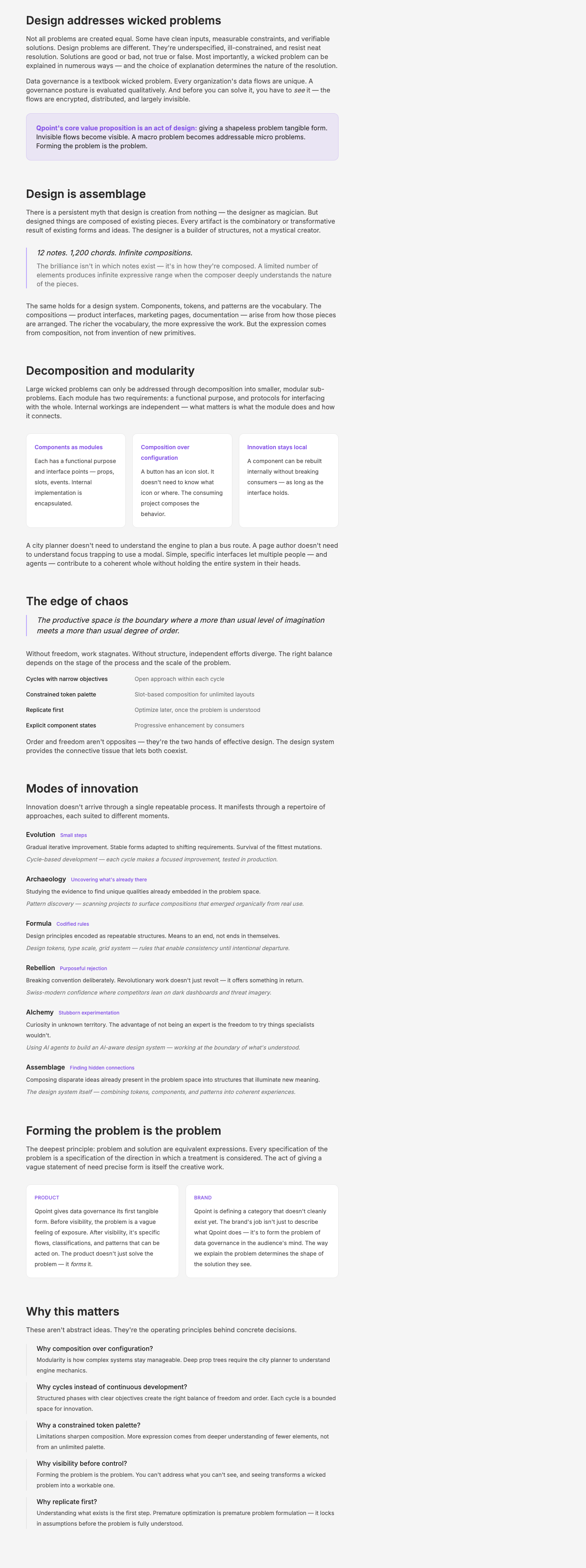
Designed presentation of the design methodology at /method. Six sections matching the standalone document's structure, rendered in the site's visual patterns:
- Wicked Problems — with grape callout box for the "forming the problem" insight
- Assemblage — with blockquote for the music analogy
- Decomposition — with 3-card grid (components as modules, composition over configuration, local innovation)
- Edge of Chaos — structure/freedom tension table (cycles, tokens, replicate-first, states)
- Modes of Innovation — six modes with method tags and practice examples (dropped Farce — too tangential for the page)
- Forming the Problem — product/brand split in 2-card grid
- Why This Matters — five Q&A items with grey left-border treatment
Updated: app/components/AppNav.vue
Added "Method" link between Logo and Components.
Updated: app/pages/index.vue
Added Method card to the homepage grid.
Build passes cleanly.
Outcome — Phase 3
New MCP resource: brand://qpoint/method
Added to mcp/src/resources.ts. Reads brand/design_methodology.md from disk on each request (same pattern as the guide resource). Description: "how we think about design: wicked problems, assemblage, decomposition, modularity, modes of innovation, and the 'forming the problem' principle." MCP server type-checks and builds cleanly.
New writing principle: "Form the problem, then solve it." Added to five locations:
brand/qpoint_brand_foundation_v1.5.md— section 05, Writing Principlesbrand/qpoint_brand_essential_guide_v1.5.md— Writing Principlesapp/pages/brand/index.vue— principles arrayserver/data/brand.ts— writingPrinciples array (feeds/api/brand/voice)
The principle: "Lead with the problem's shape — not the solution's features. We don't just solve data governance — we give it form."
Outcome — Phase 4
Positioning language added to brand/design_methodology.md appendix:
- 5 headline candidates (visibility-first, problem-forming frames)
- 3 positioning paragraphs: problem-first (wicked-problem frame), assemblage frame (design/engineering audiences), process narrative (how-we-build content)
- 4 tagline directions with rationale
All four phases complete. Build passes.
Thesis → Qpoint Connections
1. Wicked Problems Are Qpoint's Domain
The thesis defines wicked problems as underspecified, ill-constrained, with no enumerable set of solutions — where "the choice of explanation determines the nature of the problem's resolution." Data governance is a textbook wicked problem:
- No definitive solution. Every organization's data flows are unique. There is no universal "correct" policy.
- Solutions are good-or-bad, not true-or-false. A governance posture is evaluated qualitatively — is it proportional? Does it enable the business?
- Forming the problem is the problem. Before Qpoint, organizations can't even see their data flows. The first act of design — giving the problem tangible form — is literally what Qpoint does: it makes invisible flows visible, turning a macro problem into addressable micro problems.
Application: This framing elevates Qpoint from "security tool" to "design instrument." The product doesn't just enforce policy — it gives wicked problems shape so they can be reasoned about. The thesis's language of problem formulation ("the formulation of a wicked problem IS the problem") directly describes Qpoint's value proposition.
2. Decomposition + Modularity = Design System Practice
The thesis argues that large wicked problems can only be addressed through decomposition into modular patterns with clear interfaces — exactly what a design system does:
- Components as modules. Each component has a functional purpose and interface points (props, slots, events). Internal implementation is independent of the larger system.
- Composition over configuration. The thesis's bus analogy — the city planner doesn't need to know if the bus runs on combustion or nuclear power, only that it arrives at 45th at 5:00 — mirrors the component philosophy's emphasis on slots over deep prop trees.
- Shared consciousness through shared language. The thesis calls for "common terms for painting the big picture without obscuring the nature of the pieces." The design system — tokens, components, patterns — is exactly this shared language.
Application: The component philosophy (brand/component_philosophy.md) already embodies these ideas. Making the connection explicit strengthens the intellectual foundation and helps explain why composition-over-configuration isn't just a preference — it's a methodological necessity for managing complexity.
3. Design as Assemblage (Not Creation from Nothing)
Part Two's central argument — that design is the composition of existing meaning-laden pieces, not mystical creation ex nihilo — maps directly to how we build:
- "The designer is a builder of structures, not a mystical creator." This demystifies both human design work and AI-assisted design. Agents aren't creating from nothing; they're identifying relevant pieces and composing them.
- The music analogy. 12 notes → 1200 chords → infinite compositions. 60+ components → documented patterns → infinite applications. The brilliance isn't in the pieces but in their arrangement.
- Problem space delineation. The thesis's concept of identifying the problem space, then finding the relevant pieces within it, describes exactly what the
/scan-patternsskill does — it looks into a project, identifies the pieces, and surfaces how they compose.
Application: This reframes the design system not as a constraint but as a creative vocabulary. The richer the vocabulary (more components, better tokens, clearer patterns), the more expressive the compositions.
4. Collective Sketching = Agent-Era Collaboration
The thesis's most prescient idea: teams need methods for "collective sketching" — shared, evolving representations of both the problem and the process. The thesis notes that object-oriented programming solved this for code (modular, interfaced, individually innovative). Design needs the same.
In 2026, this maps directly to human-agent collaboration:
- Agents as team members. The thesis describes specialists who need "shared protocols and common terms." MCP servers, brand resources, and component registries serve exactly this function for AI agents.
- The edge of chaos. "That point where a more than usual level of imagination meets a more than usual degree of order." This perfectly describes effective agent workflows — enough structure to maintain coherence (CLAUDE.md, cycles, component philosophy), enough freedom for genuine innovation.
- External systemic representation. The thesis argues teams need a shared consciousness — "an external systemic representation of the problem." The design site, brand API, and MCP server literally externalize the brand's consciousness for both humans and agents.
Application: Qpoint can articulate that its design system isn't just documentation — it's an externalized shared consciousness that enables both human designers and AI agents to participate in the collective sketch.
5. Seven Modes of Innovation
The thesis catalogues seven approaches to innovation. Several are already active in Qpoint's practice:
| Mode | Thesis Description | Qpoint Practice |
|---|---|---|
| Evolution | Small iterative improvements | Cycles — small, focused increments |
| Archaeology | Uncovering what's already embedded in the problem space | /scan-patterns — discovering compositions already in use |
| Math / Formula | Codified design rules applied with proper perspective | Design tokens, Tailwind config, typographic scale |
| Rebellion | Breaking convention purposefully | "Replicate first, optimize later" — rebellion only after understanding |
| Alchemy | Experimentation in unknown territory | The agent experiment itself — using AI to build AI-aware design systems |
Application: These modes could frame how Qpoint talks about its design process — not as a single methodology but as a repertoire of approaches chosen based on the nature of the problem.
6. Forming the Problem Is the Problem
The thesis's most powerful insight: "the formulation of a wicked problem IS the problem" — problem and solution are equivalent expressions. This has a double application:
- Product: Qpoint forms the problem of data governance by making flows visible. Before visibility, the problem has no shape.
- Brand: Qpoint's brand challenge — explaining a category that doesn't cleanly exist yet — is itself a wicked problem. The brand doesn't just describe Qpoint; it forms the problem of data governance in the audience's mind.
Application: This positions Qpoint as a company that understands it's not just solving problems but defining them. That's a more sophisticated and accurate description of what category-creating companies do.
Proposed Deliverables
Given the depth of these connections, here's what I'd recommend building:
Tier 1: Brand Foundation Update
- Update
brand/component_philosophy.md— Add a "Design Lineage" section connecting the seven principles to the thesis's framework (decomposition, modularity, assemblage) - Update
brand/qpoint_brand_foundation_v1.5.md— Add a "Design Method" section under brand principles that articulates the wicked-problem framing and collective-sketching model - New file:
brand/design_method.md— Standalone document capturing the thesis-to-Qpoint mapping in full. Referenced by brand foundation, available via MCP
Tier 2: Design Site Page
- New page:
/method— A designed presentation of these ideas on the design site. Not a thesis summary — a Qpoint-specific articulation of design as method, showing how these principles manifest in the product, the brand, and the system - Visual treatment: timeline/process diagram, the assemblage concept illustrated with component compositions, the wicked-problem framing applied to data governance
Tier 3: MCP + Agent Integration
- New MCP resource:
brand://qpoint/method— Makes the design method accessible to agents, so they can understand why the design system is structured as it is - Update brand voice guidelines — Add the "forming the problem" concept to how we talk about Qpoint's value (we don't just solve data governance, we give it shape)
Tier 4: Marketing Language
- Positioning language — Draft language that uses the wicked-problem framing for marketing: "Data governance is a wicked problem. Before you can solve it, you have to see it."
- Design process narrative — How Qpoint was designed, told through the thesis's five phases
Decisions
- Naming: "Design Methodology" (not "Design as Method")
- Attribution: Mostly absorbed into the brand voice with occasional casual mention — no academic citations
- Agent angle: Internal-only for now. The collective-sketching / shared-consciousness connection to agent workflows is noted as a future outward-facing opportunity
- Scope: Execute all four tiers as a series of phases within this cycle
Key Learnings
- PDFs are ingestible but require tooling. The thesis PDF needed
poppler(pdftotext) to extract text. The Read tool's built-in PDF rendering requirespdftoppmwhich wasn't installed. Once extracted to plain text, the full 1,678-line thesis was straightforward to work with. For future cycles involving PDFs:brew install poppler+pdftotext file.pdf -is the reliable path. - Absorbed voice is harder than citation. Writing "in the voice of" rather than "about" the thesis required fully digesting the ideas and re-expressing them through Qpoint's existing brand language. The result reads as natural extension of the brand — not an academic summary bolted on. This took more thought but produced a better artifact. Academic citations would have created distance between the ideas and the brand.
- Brand docs, site page, and API data must stay in sync. Adding the "Form the problem" writing principle required updates to five files: foundation doc, essential guide, brand page Vue component, server data TypeScript, and the MCP resource implicitly (it reads the markdown). When adding brand-level concepts, trace the full chain: source markdown → essential guide → site page → API data → MCP resources.
- The thesis's ideas were already embedded in the practice. Composition over configuration, replicate-first, cycle-based development, pattern discovery — these were all in place before the thesis connection was made explicit. The cycle didn't invent new practices; it articulated why existing ones work. This validates the approach: the methodology was already operational, it just needed language.
- Tiered phasing works for conceptual cycles. Unlike component extraction cycles (c3–c6) where the work is concrete and sequential, this cycle dealt with ideas that needed to be refined through multiple passes — prose first (Phase 1), then visual presentation (Phase 2), then integration (Phase 3), then application (Phase 4). Each phase built on the previous one's output. The tier structure from the initial plan mapped cleanly to execution phases.
- The agent-era connection is the strongest untapped angle. The thesis's "collective sketching" and "shared consciousness" ideas describe exactly what MCP servers, CLAUDE.md files, and component registries do for AI agents. This was deliberately kept internal for now, but it's a genuine differentiator — "we think about human-AI collaboration through the lens of 20 years of design methodology research" is a story no competitor can tell.
What Remains (Future Cycles)
- Outward-facing agent narrative. When the time is right, the collective-sketching / shared-consciousness connection to agent workflows could become public-facing content (blog post, marketing angle).
- Refine marketing language. The Phase 4 positioning drafts are starting material. They need testing against real marketing contexts (landing page, pitch deck, blog post).
- Visual treatment for /method page. The page is text-heavy. Future iterations could add diagrams: the wicked-problem → micro-problem decomposition, the assemblage model (notes → chords → compositions), the structure/freedom tension visualized.
Visual record
6 captures — heroes, page slices, and full-page renders. Click to view.

Artifacts
- prompt.md