App Consolidation
Understand the fractured qcontrol app ecosystem and consolidate it into a simple, clean, demoable product on a Nuxt + q-nuxt-layer front-end
Why
The product shifted to AI agent security & monitoring and took shape organically in the engineers' hands inside the qcontrol Rust monorepo. The result is a fractured application state: three separate front-ends (qdash fleet dashboard with two coexisting UIs, qglass live log inspector on a different Vue stack, qtray native macOS menu bar) plus the cloud control plane (qplane / app.qpoint.io) and a marketing product lineup (qcontrol / qtap / qplane / devtools / qscan) that doesn't map cleanly to the actual surfaces. A design effort is needed to understand everything, converge on one coherent ecosystem, and make every use case clearly demonstrable.
Objective
Six hard objectives:
- Understand what each app does — captured in
research/(done at cycle creation). - Implement a Nuxt front-end using q-nuxt-layer — building on the engineers' existing beachhead at
qcontrol/crates/qdash/ui/(Nuxt 4 on@qpoint-io/q-nuxt-layer, branchfeat/qdash-nuxt-redesign). New components created where appropriate (design-site-first, then released to the layer). Subtle dark mode — human-driven. - Use-case-driven structure — every core use case (run, scan, tap, monitor, inspect, dashboard) is clearly demonstrable and demo-able. Simple, makes sense.
- Docs site — design + populate a new dedicated docs project (docs.qpoint.io) consuming q-nuxt-layer.
- Fix the cookies permission on www.qpoint.io — research shows this is a build, not a fix: no consent system exists in code.
- Adopt useful qcontrol agent processes — the
to-prd→to-planpipeline transfers to design work.
Scope
../qcontrol/crates/qdash/ui/— the consolidation target front-end../q-nuxt-layer/— new/extended components and dark-mode tokens- New docs project (to be scaffolded, sibling directory)
../www.qpoint.io/— cookie consent builddesign/.claude/skills/— adopted process skills- This cycle's docs:
research/(four research docs),plan.md(workstream plan)
Key Changes
- ✓ Researched the qcontrol suite (17 crates, 3 UIs, CLI surface, event contract, qdash API/DB), the qcontrol team's agent process skills, www.qpoint.io cookie state, qplane/app.qpoint.io, and docs-site state — saved as
research/apps.md,research/use-cases.md,research/agent-process.md,research/web-properties.md - ✓ Decisions: build on
crates/qdash/ui/(not a fresh app); docs site is a new dedicated project - ✓ Wrote
plan.md— five workstreams (ecosystem understanding, consolidated front-end, docs site, cookie consent, process adoption) - ✓ Component gap analysis (
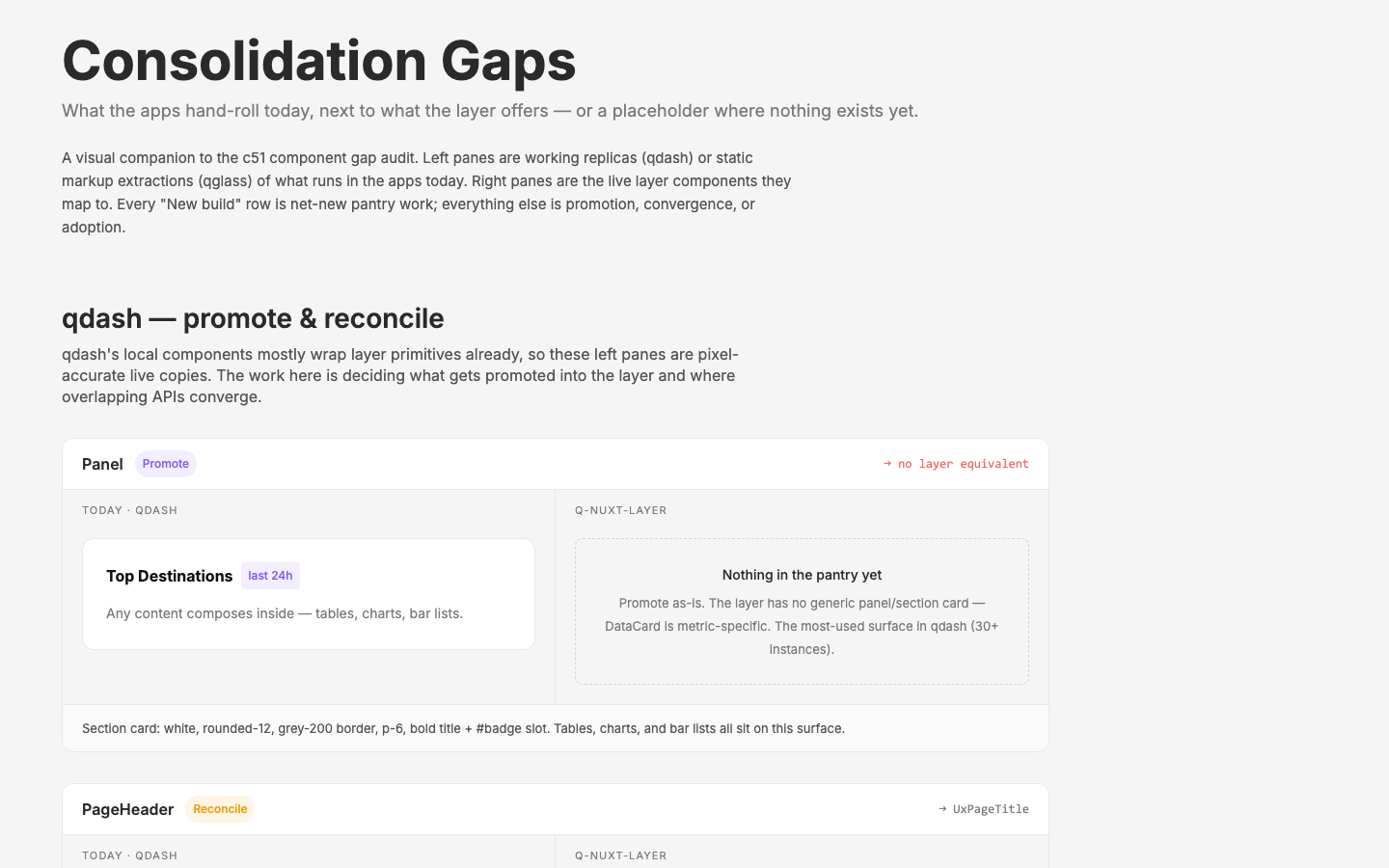
research/component-gaps.md) — inventoried qdash UI + qglass against the layer's 116 components. qdash locals mostly wrap layer primitives (promote: Panel, AppSidebar shell, AttentionStrip, BarList; converge DataTable/PermissionTable); true new builds come from qglass absorption: tabs, resizable side panel, tree multi-select, virtualized table - ✓ App inventory (
research/app-inventory.md) — product-level catalog of every piece of data and every affordance across qdash's 13 Nuxt pages, qglass's inspector (incl. the event-family taxonomy), and the 8 legacy-dashboard surfaces the port lacks. Key finding: the Nuxt port is 100% read-only — every write path (finding workflow, egress decisions, teams, channels, attestations, campaigns, controls) lives only in the legacy UI
Visual record
2 captures — heroes, page slices, and full-page renders. Click to view.

In the archive
Artifacts
- initial-prompt.md
- initial-prompt.md
- plan.md
- sarah-runbook.md